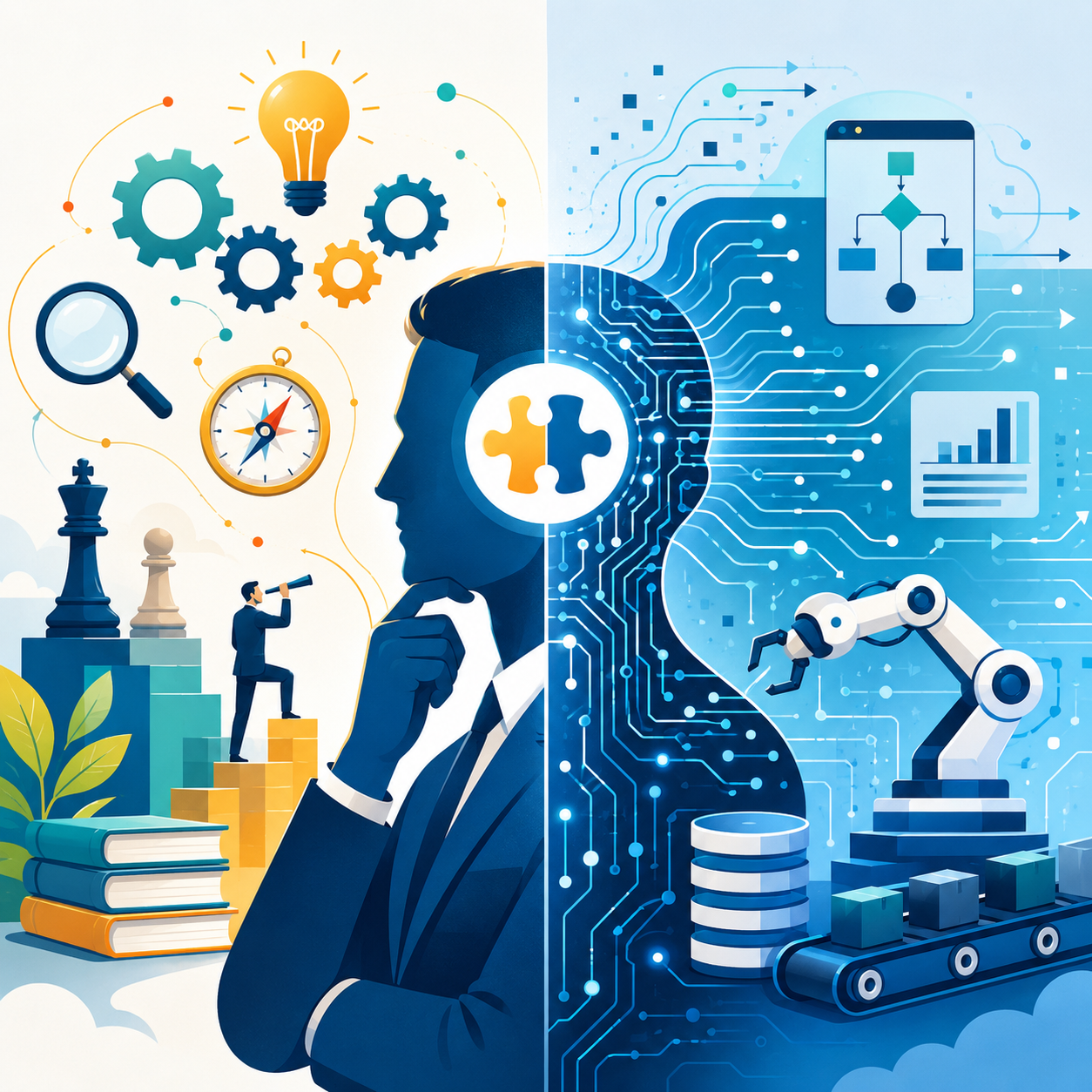
Generative AI is becoming a powerful tool that increases corporate speed and reduces costs. However, reckless automation can weaken the judgment, expertise, and problem-solving capabilities that companies have built up over a long period of time. In the age of AI, true competitiveness depends less on what should be handed over to AI and more on deciding what should remain as a core human capability.
[Key Message]
* AI can make companies stronger, but if used poorly, it can weaken their core capabilities.
* The real risk of generative AI is not task automation itself, but the replacement of human judgment and problem-solving ability.
* Corporate competitiveness comes not from faster outputs, but from accumulated expertise, field insight, and a unique way of making judgments.
* As AI more easily takes over drafting and analysis, the ladder of learning through trial and error can become weaker for employees.
* The core strategy in the AI era is not simply deciding what to automate, but deciding what should remain as a core human capability.
***
The Paradox of AI Adoption: Organizations Become Faster, Yet Weaker
Companies are now embracing generative AI as a core tool for improving productivity. The areas of work in which AI is involved are rapidly expanding, from drafting reports, organizing meeting minutes, handling customer inquiries, conducting market research, writing code, analyzing data, creating marketing copy, assisting with personnel evaluations, and reviewing legal documents. Tasks that once required several people to work for days can now be turned into drafts within minutes. Information searches become faster, documents become more polished in form, and the time spent on repetitive work is reduced. On the surface, companies appear to be transforming into faster and more efficient organizations.
But speed is not the same as capability. Companies have maintained their competitiveness over a long period of time not simply because they handled work quickly. Their real capability is formed by judgment built through countless trials and errors, the ability to sense subtle changes in the field, the capacity to understand the needs hidden behind customers’ words, the perspective to interpret the flow beyond the numbers, and the power to decide what to give up and what to protect in a crisis. These abilities cannot be copied all at once like document files or installed instantly like software. They are accumulated slowly through the repeated process of thinking, failing, correcting, and judging again by people and organizations.
The danger of generative AI arises precisely at this point. When AI is used as a simple support tool, it becomes a powerful means of increasing productivity. However, once companies begin to hand over even the process of judgment to AI, the story changes. At first, they entrust AI with drafts. Next, they entrust it with analysis. Then they entrust it with the selection of alternatives. At some point, the organization reduces the time it spends thinking for itself and becomes accustomed only to reviewing the answers suggested by AI. The number of outputs increases, but the ability to explain why those outputs came out that way weakens. Data becomes abundant, but the ability to question and reinterpret that data diminishes.
When companies adopt AI, the question they commonly ask is, “Which tasks can be automated?” Yet the more important question is, “Which capabilities must never be automated?” Automation reduces costs and increases speed, but in that process, an organization’s core capabilities can disappear along with it. In particular, if expertise and judgment accumulated over a long period are easily replaced in the name of short-term efficiency, a company may appear on the outside to be an organization using advanced technology, while internally becoming increasingly fragile.
The real danger of the AI era does not lie only in machines becoming smarter than humans. The more realistic danger lies in humans thinking less for themselves. As people become accustomed to AI giving them answers, their ability to create questions may weaken. As they become accustomed to AI generating drafts for them, they may have fewer experiences of grappling with a problem from the beginning. As AI offers quick judgments, organizations may lose the ability to think slowly but deeply. As a result, companies may produce more outputs more quickly, while losing the very muscles of thought that have supported their competitiveness.
Core Capabilities Are Not Lists of Tasks, but Ways of Making Judgments
If corporate core capabilities are understood simply as specific tasks or technologies, the risks of AI adoption cannot be seen properly. Core capabilities are closer to “how one judges” than to “what one does.” Even when preparing the same report, one company may merely organize surface-level information, while another may detect signs of a new market within it. Even when looking at the same customer data, one company may read only simple purchasing patterns, while another may discover discomforts and desires that customers have not yet expressed. Even in the same crisis situation, one organization may think only of cost reduction, while another may choose to protect long-term trust and brand assets. This difference is the unique capability of a company.
For example, the competitiveness of a consulting firm does not lie only in making attractive presentations. It lies in interpreting the client’s complex situation, identifying the structural causes behind the problems visible on the surface, and designing alternatives that can actually be implemented. The competitiveness of a manufacturing company also does not lie only in quickly drawing up production schedules. It lies in detecting small abnormal signals in the field, tracing the causes of quality problems, and predicting how far cracks in the supply chain may spread. The competitiveness of a financial company also does not lie only in quickly preparing product descriptions. It lies in making judgments that consider customers’ risk preferences, market volatility, the regulatory environment, and long-term trust together.
Such judgment cannot be created in a short period of time. Nor does it emerge simply because seniors transfer knowledge to juniors. It must be built through experience in the field, meeting customers, reviewing failed decisions, analyzing the reasons behind successful strategies, and reading both numbers and people’s reactions together. That is why an organization’s core capabilities are often invisible. They are not written in manuals, they cannot be fully explained through training materials, and they cannot be measured by a single performance indicator. Yet in actual moments of competition, it is precisely these invisible abilities that determine victory or defeat.
It is possible for AI to support this area. It can organize vast amounts of material, present multiple perspectives, and point out variables that may easily be missed. However, if even the muscles of final judgment become dependent on AI, core capabilities will gradually weaken. At first, people review AI’s answers, but the more this is repeated, the more people begin to think on the premise of AI’s answers. An organization that once asked, “Is this judgment correct?” may at some point begin asking, “AI said this, so why should we do it differently?” The starting point of judgment shifts from humans to AI.
This change takes place quietly. An organization’s expertise does not disappear suddenly one day. At first, small tasks are handed over in the name of efficiency. Next, analysis is entrusted to AI because there is not enough time. Later, part of decision-making is relied upon because people believe AI will be more accurate. Over time, members of the organization have fewer experiences of interpreting data and creating alternatives on their own. As a result, the tacit knowledge, intuition, field sense, and problem-solving methods that remained inside the organization are not sufficiently passed on to the next generation.
The core capabilities that companies must protect are usually hidden in the slowest, most cumbersome, and most human processes. These include meeting customers directly and listening to the nuances of their complaints, having several people discuss strange changes in the market, reviewing failed projects in uncomfortably close detail, and listening to field instincts that cannot be explained by numbers. AI can help with these processes, but it cannot fully replace them. If companies fail to distinguish this difference, the most important capabilities may weaken first.
AI Can Cut Off the Ladder of Learning
One of the greatest effects generative AI has on corporate organizations is that it changes employees’ learning paths. This change is especially important in the growth process of new employees and working-level staff. Expertise is not developed simply by receiving completed outputs. It is formed through repetition: searching for materials, writing drafts, making mistakes, correcting them, receiving feedback, and thinking again. This process, which may appear inefficient, is actually a training ground for developing judgment.
In the past, a new employee went through many trials and errors to write a single report. They wandered because they did not know what materials were important, failed to answer a superior’s questions properly, rewrote sentences because the logic did not fit together, and were told that the core point was missing. This process was sometimes frustrating and slow, but it was precisely through that time that they came to understand the structure of work. They learned through experience what information matters, which evidence is weak, what expressions carry responsibility, and what conclusions are actually executable.
If AI creates drafts too easily, this training process may shrink. A new employee receives a plausible document from the beginning. The sentences are smooth, the structure is organized, and the key items appear to be listed without omission. However, because the employee has not directly experienced the thinking process that produced the document, they may not properly understand why such a structure is necessary, which evidence is strong or weak, or which conclusion is risky. The output exists, but the process of growth is empty.
This problem is not limited to individual proficiency. It is connected to generational succession across the entire organization. Today’s working-level employees become tomorrow’s managers and leaders. If they do not accumulate enough experience in thinking and judging during the working-level stage, future leaders will find it difficult to make deep judgments when they encounter larger problems. If talent raised in an environment where AI is always present does not acquire the ability to think even without AI, the organization’s leadership foundation may weaken in the long term.
Problem-solving ability, in particular, is not developed by quickly obtaining the right answer. Rather, it is developed by defining the problem in a situation where the answer is not visible, separating possible causes, building hypotheses, verifying them, discarding failed hypotheses, and approaching the problem again. AI can help this process move faster, but it becomes a problem if it causes the process itself to be skipped. If AI takes over all the time humans should spend thinking for themselves, the organization will develop only the ability to consume answers, not the ability to solve problems.
Therefore, education and training in the AI era must change. It is not enough simply to teach “how to use AI well.” Organizations must also teach “how to question the answers AI produces,” “which judgments humans must make directly,” and “which work experiences should be deliberately preserved.” Even if AI creates a draft, employees should be made to reconstruct its logic. They should not be allowed to submit AI-generated analysis as it is. In important decisions, they must be required to explain the grounds for human judgment.
To protect long-term competitiveness, companies must preserve the ladder of learning. Eliminating every inefficiency is not always the right answer. Some inefficiencies are not waste, but training. Some trials and errors are not costs, but part of the process of capability formation. AI can reduce parts of this process, but it must not eliminate it entirely. If companies miss this point, productivity may appear to improve now, but a few years later they may become organizations lacking people who can judge for themselves.
If Everyone Uses the Same AI, Differentiation Also Disappears
AI adoption increases corporate efficiency, but at the same time it can weaken differentiation among companies. If many companies use similar AI tools, ask questions in similar ways, and receive similar outputs, the forms of their strategies, documents, and ideas may increasingly come to resemble one another. The answers AI provides are generally based on average data and common patterns. They are fast and useful, but precisely for that reason, originality and uniqueness can weaken.
Corporate competitiveness does not come from average answers. It comes from the ability to see problems others do not see, to value variables others do not consider important, and to find possibilities in markets others have abandoned. Even within the same industry, strong companies have their own perspectives. Some companies interpret the market around customer experience, while others look at the future around technological accumulation. Some companies emphasize cost efficiency, while others place greater importance on trust and quality. These unique perspectives create differences in strategy.
However, if companies depend excessively on AI-generated analysis and suggestions, their language and thinking may become similar. Report titles become polished, sentences become fluent, and lists of alternatives become abundant. But the perspective contained within them may become ordinary. Phrases such as “customer-centric,” “data-driven,” “strengthening efficiency,” “accelerating innovation,” and “risk management” can be said easily by anyone. The real issue is the ability to make those phrases concrete in a way that fits one’s own organization, customers, technologies, culture, and field experience.
AI quickly provides general principles. But strategy begins by going beyond general principles. Why are our customers different from other customers? Where is the bottleneck in our industry? What does our organization do better than others? Which competitor’s approach should we absolutely not imitate? What value should we protect over the long term even if it does not look efficient right now? AI cannot answer these questions on its own all at once. It can assist with answers, but the organization must take responsibility for them.
In an era when everyone uses AI, the use of AI itself is unlikely to remain a differentiating factor. In the past, early adoption of digital tools alone could create a competitive advantage. However, generative AI is rapidly becoming universal. Small and medium-sized companies, large corporations, and startups can all access similar tools. In the end, the difference lies not in whether a company possesses the tool, but in its ability to interpret and control the tool.
A company that can rework AI’s average answers through its own unique organizational perspective can become stronger. Conversely, a company that mistakes AI’s plausible sentences for strategy can become weaker. What matters is not obtaining more answers through AI, but developing the ability to determine which of those answers fit the organization and which do not. No matter how many options AI presents, an organization without criteria for selection will eventually walk an average path.
That is why corporate identity becomes even more important in the AI era. For which customers does the company exist? Which problems does it solve best? Which values will it not give up? What kind of growth does it pursue? A company with clear answers to these questions can use AI in its own way. Conversely, a company with a weak identity is more likely to be dragged along by the general principles AI provides. Technology has become powerful, but the compass that holds that technology and determines direction must still remain within people and organizations.
Companies Must Distinguish What to Entrust to AI and What to Keep Human
The most important task in AI adoption is setting boundaries. Rather than asking whether every task can be replaced by AI, companies must distinguish which tasks can be entrusted to AI and which tasks humans must continue to hold onto. Without this distinction, companies may automate even their most important capabilities in the name of efficiency.
Tasks suitable for AI are generally repetitive and standardized. These include organizing document formats, summarizing meetings, conducting simple information searches, drafting documents, assisting with translation, generating basic code structures, performing first-stage data classification, and responding to basic customer inquiries. When AI is used for such tasks, the time-saving effect can be significant. It helps people focus on more important judgment and creative problem solving.
However, not every task has the same nature. Strategic decision-making, building relationships with key customers, responding to crises, making ethical judgments, setting brand direction, selecting new businesses, designing organizational culture, and evaluating and developing talent are not tasks where only quick answers matter. In these areas, context, responsibility, value judgment, and long-term consequences must be considered together. AI can provide reference materials, but it must not replace final judgment.
For example, in responding to customer complaints, AI can organize past cases and draft replies. However, humans must judge what the customer is truly angry about, how the issue will affect long-term trust, and how far the company should take responsibility. In personnel evaluation as well, AI can organize data and show patterns. However, humans must consider a person’s growth potential, relationships within the organization, the context of performance, and the psychological impact that evaluation will leave behind.
The common feature of tasks that should not be entrusted to AI is that they involve responsibility. Corporate decisions are not simply the result of information processing. They affect customers, employees, partners, shareholders, and society. Wrong decisions can lead not only to costs but also to the loss of trust. AI can present statistically plausible answers, but it does not take responsibility for the consequences of those answers. A structure in which judgment is entrusted to an entity that does not take responsibility, while humans bear the responsibility, is highly dangerous.
Therefore, the principle of AI use should be based not on “automation potential” but on “capability preservation.” Companies must ask: When a task is automated, does the organization’s core capability weaken? If a particular experience is reduced, does the growth path of future talent get cut off? If a certain judgment is handed over to AI, does the organization’s unique perspective become blurred? These are the questions that must be asked. AI strategy should not be merely a technology adoption plan, but a blueprint for organizational capabilities.
A good company is not one that uses AI a lot. It is one that can decide for itself how far AI should be used. It uses AI boldly where efficiency is needed, but leaves human thought in place where judgment is required. It does not quickly accept the answers AI presents, but reexamines them through the organization’s experience, values, and understanding of customers. Only such a company can use AI as a tool. A company that cannot do so may have its way of thinking taken over by AI.
Organizational Design Must Preserve Human Judgment
To prevent AI from weakening a company’s core capabilities, individual caution alone is not enough. Organizational-level design is needed. Simply telling employees, “Do not rely too much on AI,” will not change actual work practices. Devices that preserve human judgment must be built into performance evaluation, training systems, meeting methods, decision-making procedures, and work assignments.
First, in important decision-making, the grounds for human judgment must be clearly recorded regardless of whether AI was used. What matters is not what kind of draft AI produced, but whether a person can explain why that alternative was chosen. The statement “AI suggested it” cannot serve as a reason. A person must explain which data was important, which variables were excluded, which risks were accepted, and why this option is better than the alternatives.
Second, new employees and working-level staff must be given processes in which they deliberately do things themselves. If AI creates every draft, learning opportunities decrease. It is necessary first to have people define the problem and shape the structure themselves, and then use AI as a support tool. More important than having employees submit AI-written documents is training them to criticize and revise AI’s outputs. The ability to use AI well is not simply the ability to write good commands, but the ability to review AI’s answers and correct them responsibly.
Third, the culture of discussion and review must be maintained within the organization. As AI provides quick answers, meetings may decrease and review processes may become simplified. However, not every review is inefficient. Good judgment emerges from the process in which perspectives from different departments collide, field experience and data analysis clash, and short-term performance and long-term risks are discussed. AI can organize answers, but the process in which the organization thinks together about those answers must not disappear.
Fourth, a company’s unique knowledge and experience must be reflected in its AI usage system. The general knowledge provided by external AI tools alone cannot create organizational competitiveness. Customer cases, failure cases, field know-how, industry-specific judgment criteria, brand principles, and ethical standards accumulated by the company must be connected to the process of using AI. Only then can AI become a tool that expands the organization’s unique knowledge rather than replacing its thinking.
Fifth, the limits of AI use must be clearly defined. In particular, strict standards must be set in areas involving sensitive customer information, legal responsibility, personnel and evaluation, safety and quality, and ethical choices. If AI is allowed to penetrate every area simply because it is convenient, it may become difficult to control later. What appears to be a small exception in the early stage of technology adoption can become an organizational practice over time.
This design is not meant to reject AI. Rather, it is a condition for using AI better. An organization with weakened human capability cannot use AI properly either. If it lacks the ability to evaluate AI-generated answers, it cannot filter out wrong results. If it lacks a unique organizational strategy, it cannot turn AI’s average answers into differentiated execution. If its field sense is weak, it cannot detect important variables that AI has missed. Ultimately, a company that uses AI well is not one that reduces human capability, but one that makes human judgment more sophisticated.
Competitiveness in the AI Era Does Not Lie in Reducing Humans
Whenever AI emerges, companies tend to think first of workforce reduction and cost savings. Of course, some tasks may decrease, and some roles may change. However, true competitiveness in the AI era does not lie only in using fewer people. More important is defining more clearly what humans should do.
In the past, people had to spend a great deal of time on repetitive work. They used much of their energy organizing data, creating documents, adjusting formats, and searching for information. AI can reduce this burden. Then the time that remains should be used for deeper thinking, better judgment, and more creative problem solving. In reality, however, that remaining time may simply be filled again with more work and faster output production. In that case, AI may become not a tool that expands human thinking, but a tool that turns humans into faster processing machines.
Companies must ask not only what they can reduce through AI, but also what they will increase. If repetitive work has been reduced, will they increase the time spent understanding customers more deeply? If report-writing time has been reduced, will they increase the time spent on strategic discussion? If research time has been reduced, will they increase the time spent verifying hypotheses and checking the field? If drafting time has been reduced, will they increase the time spent reviewing the responsibility of language and the coherence of logic? Without these questions, the efficiency created by AI may simply be absorbed into an increase in workload.
Whether AI weakens or strengthens human capability is not determined by the technology itself. It is determined by how the organization uses it. If AI is seen merely as a tool for reducing labor costs, people’s learning and judgment processes will shrink. Conversely, if AI is seen as a tool for expanding thought, people can focus on higher-level problems. Even with the same technology, the outcome can be completely different depending on the philosophy with which it is adopted.
Strong companies of the future will not focus only on replacing people through AI. Instead, they will boldly entrust AI with the work it can do, while raising the level of work that humans must do better. The ability to understand customers, coordinate complex interests, make responsible choices under uncertainty, ask new questions, and protect organizational values will become more important. In an era when AI makes answers well, the ability to ask good questions becomes more valuable. In an era when AI writes sentences well, the ability to judge what should be said becomes more important. In an era when AI organizes data well, the ability to determine which data is meaningful becomes more necessary.
Ultimately, corporate competitiveness in the AI era comes not from a confrontation between technology and humans, but from the redistribution of roles. Organizations become stronger when they precisely divide the boundary between what AI should handle and what humans should hold onto, and when they use AI’s speed and scalability without weakening human judgment. Conversely, organizations that view everything only from the perspective of automation potential may gain short-term efficiency while losing long-term capability.
Only Companies That Control AI Can Benefit from AI
AI will become even more powerful. It will read longer documents, perform more complex analyses, engage in more natural conversations, and connect with more business systems. From a corporate perspective, choosing not to use AI may become increasingly difficult. However, using AI and being led by AI are different things. What truly matters is not whether AI has been adopted, but whether AI can be controlled.
Companies that control AI first understand their own capabilities. They know what their organizational competitiveness is, which judgments must not be lost, and which experiences employees must necessarily go through. Therefore, even when they adopt AI, they do not blindly pursue full automation. They reduce repetitive work but leave core judgment intact. They entrust drafting to AI but make humans responsible for the final logic. They entrust data organization to AI but reinterpret it from the organization’s perspective. They gain efficiency while preserving the learning process.
By contrast, companies led by AI hand over work simply because the technology makes it possible. At first, cost-saving effects may appear. Document production may increase, work speed may improve, and short-term performance indicators may look better. But over time, members of the organization become increasingly accustomed to AI-generated results, and the training of thinking for themselves decreases. Internal experts diminish, field sense weakens, and the organization’s unique criteria for judgment become blurred. At that point, the company may fall into a state in which it is difficult to perform work without AI.
The warning that AI can weaken a company’s core capabilities is not a fear of technology. Rather, it is closer to a proposal to use technology more maturely. It does not mean rejecting AI, but clarifying the human role more clearly as AI is adopted. Companies must distinguish between areas that need automation and areas that need judgment, increase efficiency without cutting off the path of learning, and maintain their own organizational perspective beyond average answers.
The questions companies ask in the future must change. Companies that ask only, “What can we reduce with AI?” may become trapped in the language of cost reduction. Companies that ask, “Which human capabilities will we strengthen through AI?” can move toward the language of competitiveness. If AI helps write reports faster, humans must judge more deeply. If AI finds more data, humans must select more sharply. If AI presents more alternatives, humans must choose more responsibly.
What makes companies strong in the AI era is not AI itself. It is the thinking capacity of the organization that handles AI. Anyone can adopt technology, but judgment cannot be easily copied. Tools spread quickly, but expertise accumulated over a long period of time is not created overnight. That is why what companies must protect is not simply a way of working, but the muscles of thought. As AI becomes smarter, companies must think more deeply. As AI provides more answers, companies must ask better questions. As AI takes over more work, companies must hold more clearly onto the work that only humans can take responsibility for.
AI can make companies stronger, and it can also make them weaker. The difference depends more on organizational choice than on technological performance. What will be automated? What will be preserved? Which capabilities will not be given up? Companies that cannot answer these questions may lose competitiveness even while using AI. Conversely, companies that can answer these questions can evolve through AI into organizations that are faster, deeper, and stronger.
Reference
Harvard Business Review, April 2026, Don’t Let AI Destroy the Skills That Make Your Company Competitive