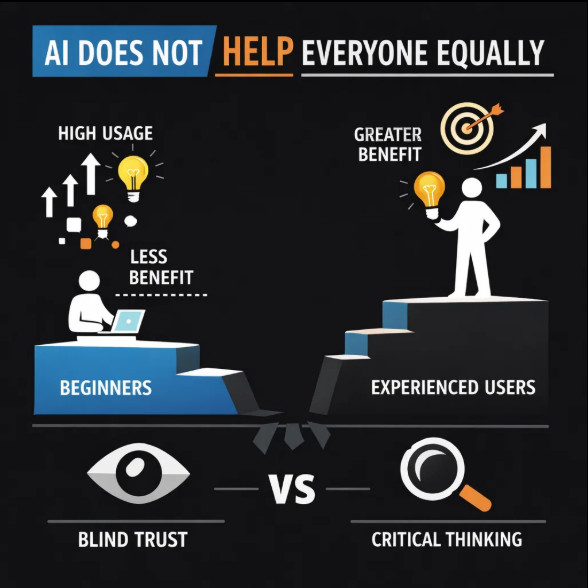
AI Does Not Help Everyone Equally
Generative AI appears to be a tool open to everyone, but its actual effects are not the same for all people.The latest research shows that even if beginners use it more often, the greater benefits may still go to experienced users. The real gap in the AI era is likely to emerge not from access itself, but from the ability to judge and verify.
AI Has Already Moved Beyond Experiment and Become the Workplace
On January 22, 2026, a study was published in the international academic journal *Science* that tracked on a large scale how deeply generative AI had entered the real world of coding. The research was led by a team consisting of Simone Daniotti, Johannes Wachs, Xiangnan Feng, Frank Neffke, and others. They analyzed the vast record of Python code contributions uploaded to GitHub from 2018 to 2024 and applied a classification model to track the activities of roughly 160,000 to 200,000 developers, identifying which code had been written with the help of AI. The question behind the study was simple. How rapidly is generative AI spreading, and to whom do its effects return more strongly?
The results were far more striking than expected. By the end of 2024 in the United States, about 30% of newly written Python functions were estimated to have received AI assistance. This meant that generative AI was no longer merely an experimental technology used by a handful of early adopters, but had become a tool deeply embedded in actual production settings. The more important point was that this change had taken place in a very short period of time. Only a few years ago, AI coding tools were regarded as little more than “interesting assistive features,” but they have now become elements that account for a meaningful share of the real software production process. In terms of the speed of adoption alone, it would not be an exaggeration to say that generative AI has entered the workplace faster than almost any recent productivity tool.
This scene is symbolic. Technology always begins by looking like a choice for a small minority, and then at some point it turns into infrastructure. Email, search engines, smartphones, and messaging apps all followed that path. At first, they looked like optional tools that one could use or not use, but at a certain point they became environments in which it was difficult to work without them. Generative AI is walking a similar road. Today it may look like a choice, but tomorrow it may become a basic assumption. What matters now is not whether one uses AI or not, but who gains greater benefits and who falls relatively behind in a world of work where AI has already entered.
On the surface, this technology seems as though it would favor beginners more. They can ask about syntax they do not know, receive code drafts quickly, and begin tasks in seconds that in the past would have required long periods of searching and trial and error. In fact, the study also found that less experienced developers used AI more often. Seen only from this angle, generative AI appears to be a tool that lowers technical barriers and opens new opportunities for those with less experience. Many people indeed expect exactly that. The belief that “now even beginners can work almost like experts if they use AI well” comes from this point.
But this is precisely where the study shows a direction different from what many expected. Although the share of AI usage was higher among beginners, the tangible gains in productivity, qualitative expansion of work, and exploration of new tools appeared more clearly among experienced developers. In other words, those who used it the most were not the same as those who benefited from it the most. Beginners called on AI frequently, but experienced users employed AI more strategically. Generative AI was, in effect, a tool that gave greater force not to those who merely used it more, but to those who interpreted it better and positioned it more appropriately.
Beginners Use It More Often, but Experts Gain More from It
This point is extremely important for understanding the AI era. Popular imagination surrounding generative AI contains the expectation that “everyone will be able to work like an expert.” But reality may be much more subtle. AI is a machine that produces answers, but it does not take over the task of judging whether those answers are right or wrong, whether they are appropriate to the present situation, where vulnerabilities are hidden, or what responsibilities follow from them. This is especially true in work like coding, where errors do not always reveal themselves immediately on the surface. Code that looks fine at first glance may still contain security problems, may be unfavorable for long-term maintenance, or may cause fatal errors only in particular situations.
Experienced developers can look at a draft produced by AI and identify what is missing, detect dangerous structures, and understand why a certain library was chosen and whether that approach fits the present context. Beginners, by contrast, may receive an answer that looks plausible but lack the standards by which to evaluate it. For that reason, AI often appears to beginners as “a tool that instantly gives impressive answers,” while for experienced users it becomes “a tool that saves time while allowing them to design work on a broader scale.” This difference is not small. The former may remain at the level of receiving answers, while the latter moves on to reviewing, revising, and integrating those answers into larger outcomes.
In this sense, generative AI may function less as a tool that automatically levels ability and more as a tool that adds extra leverage on top of ability that already exists. Just as giving the same hammer to a skilled carpenter and to a novice will not produce the same result, using the same AI will not necessarily produce the same quality of work. The tool is open to everyone, but the hands and eyes that handle the tool are not the same for everyone. That is why the democratization of technology does not automatically mean the democratization of capability.
If we think further about it, the value of AI increases when it is combined not with the “quantity of output” but with the “quality of judgment.” Experienced users know what to delegate to AI and what to adjust by hand. They have a feel for which prompts lead to good results, and which responses may look convincing but should not be trusted. Beginners, by contrast, are more likely either to trust AI’s output too easily or to use it too simply because they do not know how to take fuller advantage of it. In the end, what creates the difference is not AI itself, but interpretive power and contextual sense in handling AI. Even if AI is given equally to everyone as a tool, that does not mean the results become equal as well.
What Is Happening in Coding Will Soon Become a Problem for the Entire White-Collar World
This is also why the study does not end as a story confined to the software industry. What is happening in coding now is likely to spread across white-collar work more broadly. The same questions can arise anywhere generative AI enters—report writing, data analysis, planning documents, marketing copy, translation, legal drafts, customer response, and more. The ability to create a draft quickly may matter less than the ability to evaluate that draft, revise it, and reposition it in a way that fits the context.
Take report writing, for example. A beginner can use AI to produce an outline and rapidly expand sentences. But whether those sentences fit the context of the organization, whether they miss important issues, and whether the numbers and logic are consistent are matters that ultimately still require human judgment. The same is true of marketing copy. AI can instantly produce plausible slogans and lines, but preserving the tone of a brand, reading the psychology of the target audience, and avoiding risk require a much higher level of sensibility. Similar things happen with legal drafts, financial analysis, educational content, and customer response. AI creates drafts quickly, but turning them into outputs one can stand behind still requires a higher level of judgment.
As a result, beginners may find it easier to start using tools at the entrance to work, but experienced users may gain far larger productivity advantages. In this case, AI may end up functioning less as a ladder that lifts everyone at once and more as a longer ladder handed to those who were already standing higher up. This is why optimism that technology will reduce inequality does not automatically become reality. On the contrary, those who already know more may become faster and take on broader work, while those who know less may start more quickly but fail to grow in depth.
This change also affects the power structure inside organizations. In the past, a certain volume of repetitive work required a corresponding number of workers, but now the same number of people can process more with AI. This may lead companies to value those who review results and set direction more than those who merely execute repetitive tasks. In other words, the value of “people with good judgment” may rise more than that of “people who work quickly with their hands.” Generative AI is not simply a tool that increases productivity; it may also change which kinds of people organizations regard as more important.
The Problem May Be Not Jobs but the Ladder of Growth
At the level of the labor market, an even more sensitive problem emerges. In many fields, people begin with the simplest tasks and gradually learn more complex forms of judgment as they become skilled. Junior developers build intuition through repetitive code revision and debugging, and entry-level office workers learn the feel of work by repeatedly organizing documents, gathering materials, and drafting initial versions. This process may seem tedious and inefficient, but it is in fact a very important stage in the formation of expertise. People learn “why it is done this way” through repetition of small tasks, and on top of that they build larger judgment.
But if generative AI begins to replace a large share of this entry-level work, the question remains: where will people gain the experience they need in order to move up into intermediate skill levels? Right now AI is likely to make the skilled even stronger, while at the same time weakening the training path that leads to skill. This structure can improve efficiency in the short term, but in the long term it may destabilize the ladder through which talent develops. Almost no one begins with fully formed judgment. Most people grow by doing simple tasks, learning through mistakes, and gradually developing instinct. But if those entry-level tasks begin to disappear, society will face the larger question of how it is supposed to cultivate the skilled workers of the future.
This is also a burden for companies. In the short term, reducing entry-level hiring and increasing the productivity of skilled workers with AI may look efficient. But if, a few years later, there are not enough new middle managers, senior practitioners, and skilled experts, that efficiency may return as a future cost. The same is true for schools. It is not enough simply to set rules saying “AI may be used” or “AI must not be used.” What matters more is how students and new workers will learn to question, verify, and revise AI’s answers. In the end, what companies and society need to think about is not whether to adopt AI. What may matter more is how to redesign the very process through which entry-level people learn judgment and responsibility.
At the same time, there is also a positive possibility. If AI reduces simple repetitive work, people may be able to move more quickly into areas of more complex judgment. The problem is that this does not happen automatically. There must also be structures in place in which someone teaches, reviews, gives feedback, and allows people to learn through failure. Otherwise, AI may become not a tool that helps learning, but a cover that conceals the empty spaces where learning should have occurred. On the surface, everything may look faster, but underneath, there may be more cases in which skill remains hollow.
The Accuracy of the Eye Matters More Than the Speed of the Hand
That is why, in the AI era, competitiveness is likely to be decided more by the accuracy of the eye than by the speed of the hand. In the past, what mattered was how quickly one could write and how much one could process. Now what matters more may be the ability to decide what to delegate and what must still be judged directly. In other words, the value of review over input, discrimination over production, and responsibility over speed is rising. Generative AI is not eliminating labor so much as shifting its center of gravity. People are gradually changing from “those who make things directly” into “those who evaluate and adjust results.”
This change is larger than it first appears. In the past, many professions revolved around “how well can you produce something.” In the future, “how well can you select” may become more important. The ability to draft directly will still matter, but the ability to decide which of several drafts is most appropriate, which parts should be discarded and which should be preserved, and where risks may emerge will create the greater difference. In the end, the human role shifts not only toward creation, but toward editing, discrimination, and responsibility.
The problem is that the abilities required for this transition are still not being trained widely enough in schools and workplaces. We still tend to evaluate speed in producing correct answers, processing large quantities, summarizing, and organizing. But if AI can already replace a substantial portion of that territory quickly, then the value that remains for humans moves elsewhere. The power to interpret, the power to doubt, the power to read context, and the power to make decisions one can take responsibility for may become more important. These abilities do not arise overnight. They require experience, mistakes, feedback, and training.
If the democratization of tools does not automatically mean the democratization of ability, then the gap of the future is likely to emerge more from interpretive power than from access. Even if everyone can use the same AI, not everyone will obtain the same result. Some people will go much farther through AI, while others may find that AI made it easier to begin but did not allow them to grow in depth. That is why the real question raised by generative AI is not “who uses it more.” It is closer to “who can read better, doubt better, and take responsibility better.” An era may already have begun in which people use the same tool, yet some climb much faster while others remain in place.
Reference
Science, 2026-01-22/2026-02-19, “Who is using AI to code? Global diffusion and impact of generative AI”, Simone Daniotti; Johannes Wachs; Xiangnan Feng; Frank Neffke
AI는 모두를 똑같이 돕지 않는다
생성형 AI는 누구에게나 열려 있는 도구처럼 보이지만, 실제 효과는 사람마다 같지 않다. 최신 연구는 초보자가 더 많이 쓰더라도, 더 큰 이익은 숙련자에게 돌아갈 수 있음을 보여준다. AI 시대의 진짜 격차는 접근 여부보다, 판단하고 검증하는 능력에서 벌어질 가능성이 크다.
AI는 이미 실험이 아니라 현장이 되었다
2026년 1월 22일, 국제 학술지 *Science*에는 생성형 AI가 실제 코딩 세계에 얼마나 깊이 들어왔는지를 대규모로 추적한 연구가 공개됐다. 연구를 이끈 것은 시모네 다니오티, 요하네스 바흐스, 샹난 펑, 프랭크 네프케 등으로 구성된 연구진이었다. 이들은 2018년부터 2024년까지 GitHub에 올라온 방대한 파이썬 코드 기여 기록을 분석하고, 약 16만 명에서 20만 명 규모의 개발자 활동을 추적하면서, 어떤 코드가 AI의 도움을 받아 작성됐는지를 식별하는 분류 모델을 적용했다. 이 연구의 질문은 단순했다. 생성형 AI는 얼마나 빠르게 확산되고 있으며, 그 효과는 누구에게 더 크게 돌아가는가.
결과는 예상보다 훨씬 인상적이었다. 2024년 말 미국에서는 새로 작성된 파이썬 함수의 약 30%가 AI 지원을 받은 것으로 추정됐다. 이미 생성형 AI는 일부 얼리어답터만 쓰는 실험적 기술이 아니라, 실제 생산 현장 속으로 깊이 들어온 도구가 됐다는 뜻이다. 더 중요한 점은 이 변화가 아주 짧은 시간 안에 일어났다는 데 있다. 불과 몇 년 전만 해도 AI 코딩 도구는 “신기한 보조 기능” 정도로 여겨졌지만, 이제는 실제 소프트웨어 생산 과정의 상당 부분을 차지하는 요소가 됐다. 기술의 확산 속도만 놓고 보면, 생성형 AI는 최근의 어떤 생산성 도구보다도 빠르게 현장 속으로 파고들었다고 해도 과장이 아니다.
이 장면은 상징적이다. 기술은 늘 처음에는 소수의 선택처럼 보이다가 어느 순간 인프라처럼 변한다. 이메일, 검색 엔진, 스마트폰, 메신저가 그랬다. 처음에는 써도 되고 안 써도 되는 선택지처럼 보였지만, 어느 순간부터는 그것 없이 일하기 어려운 환경이 됐다. 생성형 AI도 비슷한 길을 걷고 있다. 오늘은 선택처럼 보여도, 내일은 기본 전제가 될 수 있다. 지금 중요한 것은 AI를 쓰느냐 마느냐가 아니라, AI가 이미 들어온 일의 세계에서 누가 더 큰 이익을 얻고 누가 상대적으로 뒤처지는가를 읽는 일이다.
겉으로 보면 이 기술은 초보자에게 더 유리할 것처럼 보인다. 모르는 문법을 물어볼 수 있고, 코드 초안을 빠르게 받아볼 수 있으며, 예전 같으면 검색과 시행착오에 오래 걸렸을 작업을 몇 초 만에 시작할 수 있기 때문이다. 실제 연구에서도 경험이 적은 개발자들이 AI를 더 자주 사용한 것으로 나타났다. 이것만 보면 생성형 AI는 기술 장벽을 낮추고, 경험이 부족한 사람에게 새로운 기회를 열어 주는 도구처럼 보인다. 실제로 많은 사람도 그렇게 기대한다. “이제는 초보자도 AI만 잘 쓰면 전문가 못지않게 일할 수 있는 것 아닌가”라는 상상이 여기서 나온다.
하지만 바로 그 지점에서 이 연구는 기대와 다른 방향을 보여준다. AI 사용 비중은 초보자 쪽이 더 높았지만, 생산성 향상과 작업의 질적 확장, 새로운 도구 탐색 같은 실질적 이익은 숙련된 개발자에게서 더 또렷하게 나타났기 때문이다. 다시 말해, 많이 쓰는 사람과 많이 이득 보는 사람은 같지 않았다. 초보자는 AI를 자주 불러오지만, 숙련자는 AI를 더 전략적으로 활용했다. 생성형 AI는 단순히 더 많이 사용하는 사람이 아니라, 더 잘 해석하고 더 적절히 배치하는 사람에게 더 큰 힘을 실어주는 도구였던 셈이다.
초보자는 더 자주 쓰고, 숙련자는 더 크게 이득 본다
이 대목은 AI 시대를 이해하는 데 아주 중요하다. 생성형 AI를 둘러싼 대중적 상상에는 “누구나 전문가처럼 일하게 된다”는 기대가 섞여 있다. 하지만 현실은 훨씬 더 미묘할 수 있다. AI는 답을 내놓는 기계이지만, 그 답이 맞는지 틀린지, 지금 상황에 적절한지, 어디에 허점이 숨어 있는지, 어떤 책임이 뒤따르는지를 판단하는 일까지 대신해 주지는 못한다. 특히 코딩처럼 오류가 겉으로 바로 드러나지 않을 수 있는 작업에서는 더욱 그렇다. 겉보기에는 멀쩡한 코드라도 보안상 문제를 안고 있을 수 있고, 장기 유지보수에 불리할 수 있으며, 특정 상황에서만 치명적인 오류를 낼 수도 있다.
경험 많은 개발자는 AI가 만든 초안을 보며 빠진 부분을 찾아내고, 위험한 구조를 감지하며, 왜 이런 라이브러리를 선택했는지, 이 방식이 지금 맥락에 맞는지 읽어낼 수 있다. 반면 초보자는 그럴듯한 답을 받아도 그것을 평가할 기준 자체가 약하다. 그래서 초보자에게 AI는 종종 “멋진 답을 즉시 주는 도구”로 보이지만, 숙련자에게 AI는 “시간을 아끼면서도 더 넓은 작업을 설계하게 해주는 도구”가 된다. 이 차이는 작지 않다. 전자는 답을 받는 수준에 머물 수 있지만, 후자는 답을 검토하고 수정하고 통합해 더 큰 결과를 만드는 데까지 나아간다.
이 점에서 생성형 AI는 실력을 자동으로 평준화하는 도구라기보다, 이미 가진 실력 위에 지렛대를 더 얹어주는 도구처럼 작동할 수 있다. 같은 망치를 쥐어줘도 숙련된 목수와 초보자의 결과물이 다르듯, 같은 AI를 써도 누가 더 좋은 결과를 내는지는 여전히 다를 수 있다. 도구는 모두에게 열려 있지만, 도구를 다루는 손과 눈은 모두에게 같지 않다. 그래서 기술의 민주화가 능력의 민주화를 자동으로 뜻하지는 않는다.
더 나아가 생각해 보면, AI의 가치는 ‘출력의 양’보다 ‘판단의 질’과 결합될 때 커진다. 숙련자는 AI에게 무엇을 맡기고 무엇은 직접 손봐야 하는지 안다. 어떤 프롬프트가 좋은 결과를 부르는지, 어떤 답변은 그럴듯해 보여도 믿으면 안 되는지 감을 갖고 있다. 반면 초보자는 AI가 내놓은 결과를 너무 쉽게 신뢰하거나, 반대로 어떻게 활용해야 할지 몰라 지나치게 단순하게 사용할 가능성이 크다. 결국 차이를 만드는 것은 AI 그 자체보다 AI를 다룰 줄 아는 해석력과 맥락 감각이다. AI가 모두에게 같은 도구로 제공된다고 해서 결과까지 같아지는 것은 아니다.
코딩의 문제는 곧 사무직 전체의 문제가 된다
이 연구가 소프트웨어 업계만의 이야기로 끝나지 않는 이유도 여기에 있다. 지금 코딩에서 벌어지는 현상은 사무직 전반으로 번질 가능성이 크다. 보고서 작성, 데이터 분석, 기획 문서, 마케팅 문안, 번역, 법률 초안, 고객 대응까지 생성형 AI가 들어오는 곳이라면 어디서든 비슷한 질문이 생긴다. 초안을 빠르게 만드는 능력 자체보다, 초안을 평가하고 고치고 맥락에 맞게 재배치하는 능력이 더 중요해질 수 있기 때문이다.
예를 들어 보고서를 작성하는 일을 생각해 보자. 초보자는 AI를 이용해 개요를 만들고 문장을 빠르게 늘릴 수 있다. 하지만 그 문장이 조직의 맥락에 맞는지, 중요한 논점을 놓치지 않았는지, 숫자와 논리가 일관적인지는 결국 사람이 판단해야 한다. 마케팅 문안도 마찬가지다. AI는 그럴듯한 카피를 순식간에 써줄 수 있지만, 브랜드의 결을 살리고 타깃 독자의 심리를 읽고 리스크를 피하는 일은 훨씬 더 높은 감각을 요구한다. 법률 초안, 재무 분석, 교육 콘텐츠, 고객 응대에서도 비슷한 일이 벌어진다. AI는 초안을 빨리 만들지만, 책임질 수 있는 결과물로 완성하는 일은 여전히 더 높은 수준의 판단을 필요로 한다.
그러면 초보자는 일의 입구에서 더 쉽게 도구를 쓰기 시작할 수 있지만, 숙련자는 훨씬 더 큰 규모의 생산성 이득을 얻게 된다. 이 경우 AI는 모두를 동시에 끌어올리는 사다리라기보다, 원래 높은 곳에 있던 사람에게 더 긴 사다리를 건네는 결과를 낳을 수도 있다. 기술이 격차를 줄일 것이라는 낙관이 자동으로 현실이 되지 않는 이유다. 오히려 잘 아는 사람은 더 빨라지고 더 넓은 일을 하게 되며, 덜 아는 사람은 빠르게 시작은 하지만 깊이 있게 성장하지 못하는 구조가 생길 수 있다.
이 변화는 조직 내부의 권력 구조에도 영향을 준다. 예전에는 일정한 양의 반복 작업을 처리하는 인력이 필요했다면, 이제는 같은 인원으로 더 많은 양을 처리할 수 있게 된다. 그러면 기업은 단순 실행 인력보다 결과를 검토하고 방향을 잡는 인력을 더 중시하게 될 수 있다. “손이 빠른 사람”보다 “판단이 좋은 사람”의 가치가 더 올라갈 수 있다는 뜻이다. 생성형 AI는 단순히 생산성을 높이는 도구가 아니라, 조직이 어떤 사람을 더 중요하게 평가하는지까지 바꿀 수 있다.
문제는 일자리가 아니라 성장 사다리일 수 있다
노동시장 차원에서 보면 더 예민한 문제가 생긴다. 많은 분야에서 사람은 가장 단순한 일부터 시작해 점차 복잡한 판단을 배우며 숙련자가 된다. 초급 개발자는 반복적인 코드 수정과 디버깅을 하며 감을 익히고, 초급 사무직은 문서 정리와 자료 조사, 초안 작성을 반복하면서 업무 감각을 배운다. 이 과정은 지루하고 비효율적으로 보일 수도 있지만, 사실은 숙련이 형성되는 매우 중요한 시간이다. 사람은 작은 일을 반복하면서 “왜 이렇게 하는가”를 배우고, 그 위에 더 큰 판단력을 쌓아 간다.
그런데 생성형 AI가 이런 입문용 일을 상당 부분 대신해 버리면, 사람은 어디서 경험을 쌓아 중급자로 올라갈 것인가 하는 질문이 남는다. 지금 AI는 숙련자를 더 강하게 만들 가능성이 큰데, 동시에 숙련자로 가는 훈련 경로를 약하게 만들 수도 있다. 이 구조는 단기적으로는 효율을 높일 수 있지만, 장기적으로는 인재의 성장 사다리를 흔들 수 있다. 처음부터 완성형 판단력을 가진 사람은 거의 없다. 대부분은 단순한 일을 하면서 감을 익히고 실수를 통해 배우며 성장한다. 그런데 그 입문 단계의 일들이 점점 사라지면, 사회는 미래의 숙련자를 어떻게 길러낼 것인가라는 더 큰 문제와 맞닥뜨리게 된다.
이 점은 기업에게도 부담이다. 당장은 AI 덕분에 초급 인력을 줄이고 숙련자의 생산성을 높이는 것이 효율적으로 보일 수 있다. 하지만 몇 년 뒤 새로운 중간 관리자, 선임 실무자, 숙련 전문가가 부족해질 수 있다면, 그 효율은 미래의 비용으로 되돌아올 수 있다. 학교 역시 마찬가지다. 단순히 “AI를 사용해도 된다” 혹은 “AI를 쓰지 마라”라는 규칙만으로는 부족하다. 더 중요한 것은 학생과 신입 인력이 AI의 답을 의심하고 검증하고 수정하는 능력을 어떻게 배우게 할 것인가다. 결국 기업과 사회가 고민해야 할 것은 AI를 도입할지 말지가 아니다. 초급 인력이 판단력과 책임감을 배우는 과정 자체를 어떻게 다시 설계할 것인지가 더 중요해질 수 있다.
한편으로는 긍정적인 가능성도 있다. AI가 단순 반복 업무를 줄여준다면, 사람은 더 빨리 복잡한 판단의 영역으로 올라갈 수도 있다. 문제는 이것이 자동으로 일어나지 않는다는 점이다. 누군가가 가르치고, 검토하고, 피드백하고, 실패를 통해 배우게 하는 구조가 함께 있어야 한다. 그렇지 않으면 AI는 학습을 도와주는 도구가 아니라, 학습의 빈 구간을 가려 버리는 덮개가 될 수도 있다. 겉으로는 빨라졌지만 속으로는 실력이 비어 있는 상태가 늘어날 수 있다는 뜻이다.
손의 속도보다 눈의 정확성이 중요해진다
그래서 AI 시대의 경쟁력은 손의 속도보다 눈의 정확성에서 갈릴 가능성이 크다. 예전에는 얼마나 빨리 쓰고, 얼마나 많이 처리하느냐가 중요했다면, 이제는 무엇을 맡기고 무엇을 직접 판단할지 가려내는 능력이 더 중요해진다. 즉, 입력보다 검토, 생산보다 판별, 속도보다 책임의 가치가 커진다. 생성형 AI는 노동을 없애기보다 노동의 중심을 이동시키고 있다. 사람은 점점 “직접 만드는 사람”에서 “결과를 감별하고 조정하는 사람”으로 바뀌고 있다.
이 변화는 생각보다 크다. 예전에는 많은 직업에서 “얼마나 잘 만들 수 있는가”가 핵심이었다면, 앞으로는 “얼마나 잘 고를 수 있는가”가 더 중요해질 수 있다. 직접 초안을 쓰는 능력도 여전히 중요하지만, 여러 개의 초안 중 무엇이 가장 적절한지, 어떤 부분을 버리고 어떤 부분을 살려야 하는지, 어디서 위험이 생길 수 있는지 읽어내는 능력이 더 큰 차이를 만들게 된다. 결국 사람의 역할은 창작만이 아니라 편집, 감별, 책임의 방향으로 이동한다.
문제는 이런 전환에 필요한 능력이 학교와 직장에서 아직 충분히 널리 훈련되고 있지 않다는 점이다. 우리는 여전히 정답을 빠르게 내는 능력, 많이 처리하는 능력, 요약하고 정리하는 능력을 주로 평가하는 경향이 있다. 하지만 AI가 그 영역을 상당 부분 빠르게 대체할 수 있다면, 사람에게 남는 가치는 오히려 다른 쪽으로 이동한다. 해석하는 힘, 의심하는 힘, 맥락을 읽는 힘, 책임질 수 있는 결정을 내리는 힘이 더 중요해질 수 있다. 이 능력들은 하루아침에 생기지 않는다. 경험과 실수, 피드백과 훈련이 필요하다.
도구의 민주화가 자동으로 능력의 민주화를 뜻하지 않는다면, 앞으로의 격차는 접근성보다 해석력에서 벌어질 가능성이 크다. 모두가 같은 AI를 쓸 수 있어도, 모두가 같은 결과를 얻지는 못한다. 어떤 사람은 AI를 통해 훨씬 더 멀리 나아가고, 어떤 사람은 AI 덕분에 시작은 쉬워졌지만 깊이 있게 성장하지 못할 수도 있다. 그래서 생성형 AI의 진짜 질문은 “누가 더 많이 쓰는가”가 아니다. “누가 더 잘 읽고, 더 잘 의심하고, 더 잘 책임질 수 있는가”에 가깝다. 같은 도구를 써도 어떤 사람은 더 빨리 올라가고 어떤 사람은 제자리걸음을 하게 되는 시대가 이미 시작됐는지도 모른다.
Reference
Science, 2026-01-22/2026-02-19, “Who is using AI to code? Global diffusion and impact of generative AI”, Simone Daniotti; Johannes Wachs; Xiangnan Feng; Frank Neffke