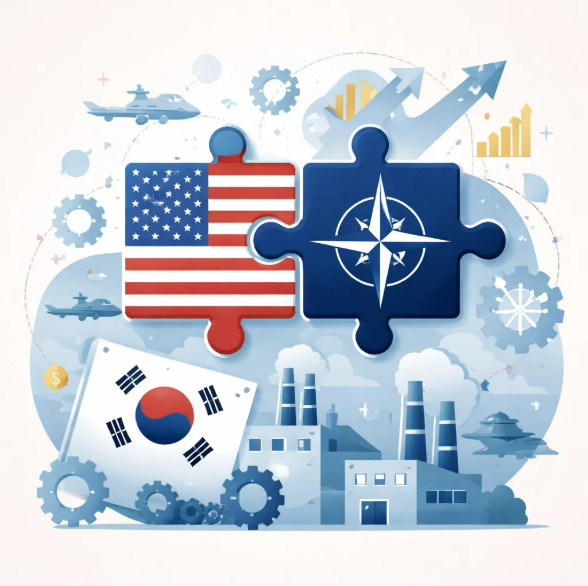
The Recontracting of the U.S.–NATO Relationship
It may look like an alliance that is shaking, but in reality a redesign is underway that reallocates roles and costs. As production capacity and the stamina of deterrence become more important than clashes of rhetoric, friction is surfacing more openly. This shift creates opportunities for South Korea in defense industry and industrial cooperation, while also demanding greater precision in diplomacy and industrial strategy.
The Substance of Alliance Redesign
These days, the conflict among the United States, NATO, and the European Union often looks like an emotional collision. But at the center is not the question of whether they are on the same side, but rather, if they are on the same side, who will take on what, and how much. This is less a scene of an alliance collapsing than a scene of rewriting the alliance’s user manual.
This redesign cannot be explained only by disputes over defense-spending numbers. Going forward, the key yardstick will be not how much money is spent, but how quickly that money turns into real capability. Tension inside the alliance grows precisely in this transition. Someone says budgets have increased, while someone else feels warehouses are empty and factories are slow. The wider the gap between words and lived reality, the more openly conflict will appear.
Another feature is how easy it is to misunderstand louder conflict as a signal that the alliance is breaking. Yet in a recontracting phase, disputes naturally increase. The more demands are specified, the more backlash becomes specific as well, and the more responsibility descends into numbers and schedules, the more readily grievances rise to the surface.
Why the Conflict Looks Bigger and Where Power Is Moving
The United States is not a country that looks only at Europe. Competition with China and the Indo-Pacific burden, Middle East variables, energy and supply chains, and domestic politics all pull at U.S. resources at the same time. Then the degree of attention devoted to Europe is adjusted depending on circumstances, and the adjustment itself is read in Europe as a major signal. What Europe is most sensitive to is not whether the United States is leaving, but whether it might be late in a crisis. The core of an alliance lies less in written promises than in the speed of response in an emergency.
Europe’s perspective has also changed. As the Russian threat has become protracted, Europe has come to look first at the stamina of deterrence rather than the alliance’s rhetoric. The more war hardens into a war of attrition, the more inventories and production become survival. At that point, Europe both accepts the reality that it must shoulder part of the burden the United States once provided, and also feels anxiety over how quickly it can actually pull it off. That is why the conflict looks bigger as differences in strategic priorities and industrial constraints become intertwined.
The language of U.S. domestic politics also amplifies anxiety. As expressions that describe alliances like transactions increase, Europe factors worst-case possibilities into its planning. From that point on, an alliance becomes not an automatically functioning device but a system whose conditions and speed must be weighed. As the system grows more complex, costs rise and decision-making slows, and that in itself creates another layer of anxiety.
A Shift in Evaluation Criteria from Numbers to Capabilities
Going forward, the central question inside the alliance is not defense-spending percentages but the speed of fielding capabilities. Even spending the same money, one country can see inventories rise while another can see only paperwork rise. In the end, an alliance is judged by how well it has prepared the ammunition, air defense, and maintenance systems that can be used in a crisis.
The areas where Europe is especially vulnerable are ammunition, air defense, and sustainment and maintenance. Artillery shells and ammunition are consumed quickly, and air-defense missiles and radars are hard to replenish in stock. Even with many platforms, if there are no spare parts and maintenance is slow, combat power weakens rapidly. So Europe has little choice but to pursue a fundamental shift toward expanding production, delivery schedules, and stockpiles rather than focusing only on purchasing.
This change makes NATO, in effect, not only a military alliance but also something closer to an industrial alliance. The longer war drags on, the more factories, contracts, and supply chains become decisive. Alliance credibility shows up more often in long-term procurement commitments, expanded production lines, and warehouse inventories than in summit communiqués. If this process does not go smoothly, conflict will inevitably continue to surface openly.
The Most Likely Scenario and the Dangerous Scenarios
The most likely direction is a division of labor in which the United States maintains the key cards and strategic assets while Europe expands on-the-ground sustainment capacity. The United States seeks to hold on to decisive capabilities—its nuclear umbrella, intelligence, surveillance, and reconnaissance, and large-scale reinforcement. Europe, meanwhile, is pushed toward taking on more of the day-to-day deterrence burden: air defense, ammunition stockpiles, ground-force operations, maintenance, and training. This change is not the same as a story in which the United States exits NATO. It is more realistic that the United States reallocates burdens and Europe absorbs them rather than the United States leaving entirely.
For this scenario to stabilize, Europe’s fielding of capabilities must actually gain speed. A virtuous cycle is needed in which plans lead to contracts, contracts lead to expanded factories, and inventories rise as a result. If that virtuous cycle forms, the alliance may become less romantic but more sustainable. The United States can lighten part of the burden in Europe while still maintaining NATO’s core, and gain room to adjust its global strategy. Europe, even without fully replacing the United States, can raise the quality of deterrence by increasing the time it can hold out in the early phase of a crisis.
A dangerous scenario is one in which, even if the alliance endures, automaticity weakens. The moment crisis-time intervention starts to look like a matter of political bargaining in terms of speed and intensity, deterrence turns into a probability game. If Europe feels that probability has declined, it buys bigger insurance by paying bigger costs, and the alliance becomes slower and more expensive. Another danger is the weakening of cohesion inside Europe. If threat perceptions diverge between Eastern and Western Europe, and plans are shaken by frequent changes of government, long-term contracts are delayed and production slows again. If such delays accumulate, the alliance’s gaps can widen.
Opportunities and Strategy for South Korea
As the alliance is reorganized around capabilities, the value of a country like South Korea—able to design production and delivery schedules—rises. What Europe wants is not a single piece of equipment, but steady volumes and a stable sustainment system. That demand opens the door to shifting defense exports from one-off deals to long-term industrial cooperation. The longer war lasts, the more inventories are depleted, and the process of refilling them continues on a multi-year timeline. This structural demand can become a long-term partnership opportunity for South Korea, beyond a short-term boom.
In particular, the biggest opportunity lies in operations rather than purchase. Once equipment is deployed, breakdowns and wear accumulate immediately, and if spare parts and maintenance lag, combat power weakens quickly. The more South Korea can provide packages that include sustainment, maintenance, training, spare parts supply, and ammunition resupply, the more its role becomes not a thin sale but a thick operational partnership. As demands for co-production, localization, and building maintenance systems grow, South Korean firms can design contracts that go beyond one-off delivery and connect into local industrial ecosystems. What matters then is not only price competitiveness but also delivery reliability, quality management, and long-term support capability.
Another axis of expansion is the maritime domain. Europe is likely to strengthen deterrence and surveillance capabilities at sea as well. Naval power is not completed by construction alone; maintenance, upgrades, and spare-parts supply create long-term stamina. South Korea’s shipbuilding and maintenance capabilities can become a new pillar of industrial cooperation as Europe expands its maritime forces. This pillar can extend into materials, electronics, communications, sensor supply chains, and deepen the layers of cooperation.
But as opportunities grow, burdens also grow. As European demand expands, allocating South Korea’s production capacity becomes harder, and pressure to meet overseas deliveries can unsettle domestic force-maintenance and stockpiling plans. Expanding exports must therefore go together with a production expansion strategy that satisfies domestic needs in parallel. Defense exports are economic contracts but are also read as diplomatic signals, so risks arising from political change must be managed as well. As demands for localization rise, if the balance between protecting core technologies and securing mutual benefit is not clarified in contracts, the industrial base could weaken over the long run. That is why South Korea’s strategy should not be mere expansion, but a path that separates risks by area and builds a production expansion structure that can meet both domestic demand and exports.
Practically, it is important to institutionalize delivery competitiveness and to bring sustainment and follow-on support to the center of exports. A sale should be the beginning, not the end, and systems for spare parts, training, and maintenance should be designed together. Technology cooperation should be built up from clearly defined tasks rather than thrown open broadly at once. Areas such as supply-chain stabilization or the parts ecosystem tend to involve relatively less political friction and offer large practical gains. By accumulating such tasks, South Korea can secure opportunities steadily within the larger currents of European rearmament and the reallocation of U.S. burdens.
What to Watch to See the Trend Clearly
Deployments and exercises reveal change before rhetoric does. If you look at which missions the United States maintains in Europe and which missions it adjusts, the substance of recontracting becomes visible. If you look at the speed at which Europe turns plans into contracts and whether those contracts lead to expanded factories, you can see the true progress of fielding capabilities.
You should also watch how quickly long-term procurement commitments are institutionalized within Europe and how much bottlenecks in procurement improve. From South Korea’s perspective, what matters is whether co-production and maintenance systems become institutionalized beyond one-off deliveries. If such structures are created, opportunity shifts from one-time exports to the expansion of industrial ecosystems.
As alliances become more calculating, that very calculus becomes an opportunity for capable partners. In an era when Europe must take on more responsibility and the United States must manage a broader set of theaters simultaneously, a country like South Korea—able to provide production capacity and operational capability as a package—can occupy a larger position than many might expect.
Reference
NATO. The Hague Summit Declaration. (Jun 25, 2025).
U.S. Congress, Congressional Research Service. The North Atlantic Treaty: U.S. Legal Obligations and Related Statutes. (Jan 6, 2025).
Reuters. US to cut roughly 200 NATO positions, sources say. (Jan 20, 2026).
NATO. Relations with partners in the Indo Pacific region. (Jun 23, 2025).
Polish Institute of International Affairs PISM. Poland and South Korea Should Further Develop Security Cooperation. (Oct 28, 2024).
미국과 나토 관계의 재계약
흔들리는 동맹처럼 보이지만 실제로는 역할과 비용을 다시 배치하는 재설계가 진행 중이다. 말의 충돌보다 생산능력과 억지의 체력이 더 중요해지면서 갈등이 더 노골적으로 드러난다. 이 변화는 한국에게 방산과 산업 협력의 기회를 만들지만 동시에 외교와 산업 전략의 정교함을 요구한다.
동맹 재설계의 실체
요즘 미국과 나토 유럽연합 사이의 갈등은 감정의 충돌처럼 보일 때가 많다. 하지만 중심에는 같은 편이냐 아니냐가 아니라 같은 편이라면 누가 무엇을 얼마나 맡을 것이냐가 놓여 있다. 동맹이 무너지는 장면이라기보다 동맹의 사용설명서를 다시 쓰는 장면에 가깝다.
이 재설계는 방위비 숫자 논쟁으로만 설명되지 않는다. 앞으로는 돈을 얼마나 쓰느냐보다 돈이 실제 능력으로 얼마나 빨리 바뀌느냐가 더 중요한 평가 기준이 된다. 동맹 내부의 긴장은 바로 이 전환에서 커진다. 누군가는 예산을 늘렸다고 말하고 누군가는 창고가 비고 공장이 느리다고 느낀다. 말과 체감의 간극이 벌어질수록 갈등은 더 노골적으로 드러난다.
또 하나의 특징은 갈등이 커질수록 동맹이 깨진다는 신호로 오해하기 쉽다는 점이다. 그러나 재계약 국면에서는 원래 분쟁이 늘어난다. 요구가 구체화될수록 반발도 구체화되고 책임이 숫자와 일정으로 내려올수록 서로의 불만이 더 쉽게 표면으로 튀어나오기 때문이다.
갈등이 커 보이는 이유와 힘의 이동
미국은 유럽만 바라보는 나라가 아니다. 중국 경쟁과 인도태평양 부담 중동 변수 에너지와 공급망 그리고 국내정치가 동시에 미국의 자원을 끌어당긴다. 그러면 유럽에 쏟는 집중력은 상황에 따라 조정되고 그 조정 자체가 유럽에는 큰 신호로 읽힌다. 유럽이 민감하게 받아들이는 것은 미국이 떠나느냐가 아니라 위기 때 늦어질 수 있느냐라는 가능성이다. 동맹의 핵심은 서류상 약속보다 위기 시 반응 속도에 있기 때문이다.
유럽의 시선도 바뀌었다. 러시아 위협이 장기화되면서 유럽은 동맹의 말보다 억지의 체력을 먼저 보게 됐다. 더구나 전쟁이 소모전의 형태로 굳어질수록 재고와 생산이 곧 생존이 된다. 이때 유럽은 미국이 제공하던 부담의 일부를 자기 힘으로 감당해야 한다는 현실을 받아들이는 동시에 그것을 얼마나 빨리 해낼 수 있는지에서 불안을 느낀다. 그래서 갈등은 전략적 우선순위의 차이와 산업적 제약이 맞물리며 더 커 보이게 된다.
미국 국내정치의 언어도 불안을 키운다. 동맹을 거래처럼 말하는 표현이 늘면 유럽은 최악의 가능성을 계획에 넣는다. 이때부터 동맹은 자동으로 작동하는 장치가 아니라 조건과 속도를 따져야 하는 시스템이 된다. 시스템이 복잡해지면 비용은 늘고 의사결정은 느려지며 그 자체가 또 다른 불안을 만든다.
숫자에서 능력으로 이동하는 평가 기준
앞으로 동맹의 중심 질문은 방위비 퍼센트가 아니라 전력화 속도다. 같은 돈을 써도 어떤 나라는 재고가 늘고 어떤 나라는 행정만 늘 수 있다. 결국 동맹은 위기 때 쓸 수 있는 탄약과 방공과 정비 체계가 얼마나 준비되어 있는지로 평가된다.
유럽이 특히 취약한 지점은 탄약과 방공 그리고 유지 정비다. 포탄과 탄약은 소모가 빠르고 방공미사일과 레이더는 재고를 채우기 어렵다. 장비가 많아도 부품이 없고 정비가 늦으면 전력은 금방 약해진다. 그래서 유럽은 구매 자체보다 생산과 납기와 비축을 늘리는 체질 전환을 추진할 수밖에 없다.
이 변화는 나토를 군사 동맹이면서 동시에 산업 동맹에 가깝게 만든다. 전쟁이 길어질수록 공장과 계약과 공급망이 핵심이 된다. 동맹의 신뢰는 정상회담의 문장보다 장기 구매 약정과 생산라인 증설과 창고의 재고로 더 자주 드러난다. 이 과정이 순조롭지 않으면 갈등은 계속 노골적으로 튀어나올 수밖에 없다.
가장 가능성이 큰 시나리오와 위험한 시나리오
가장 가능성이 큰 방향은 미국이 핵심 카드와 전략자산을 유지하고 유럽이 현장 지속 능력을 확대하는 역할 분담이다. 미국은 핵우산 정보 감시 정찰 대규모 증원 같은 결정적 순간의 능력을 쥐려 한다. 유럽은 방공 탄약 비축 지상전력 운용 정비 훈련 같은 일상적 억지의 부담을 더 떠안는 쪽으로 간다. 이 변화는 미국이 나토에서 빠진다는 이야기와는 다르다. 미국이 완전히 빠지기보다 부담을 재배치하고 유럽이 그 부담을 받아내는 그림이 더 현실적이기 때문이다.
이 시나리오가 안정적으로 굳어지려면 유럽의 전력화가 실제로 속도를 내야 한다. 계획이 계약으로 이어지고 계약이 공장 증설로 이어지고 그 결과 재고가 늘어나는 선순환이 필요하다. 선순환이 만들어지면 동맹은 낭만은 줄어도 지속 가능성은 커질 수 있다. 미국은 유럽에서 부담을 일부 덜고도 나토의 핵심을 유지하며 글로벌 전략을 조정할 여지가 생긴다. 유럽은 미국을 완전히 대체하지 않더라도 위기 초기에 버티는 시간을 늘려 억지의 품질을 높일 수 있다.
위험한 시나리오는 동맹이 유지되더라도 자동성이 약해지는 경우다. 조약은 남아도 위기 시 개입의 속도와 강도가 정치적 협상의 대상처럼 보이는 순간 억지는 확률 게임이 된다. 확률이 낮아졌다고 느끼면 유럽은 더 큰 보험을 들기 위해 더 큰 비용을 치르고 동맹은 더 느리고 더 비싸진다. 또 다른 위험은 유럽 내부의 결속이 흔들리는 경우다. 동유럽과 서유럽의 위기 인식이 갈라지고 정권 교체로 계획이 흔들리면 장기 계약이 지연되고 생산은 다시 늦어진다. 이런 지연이 누적되면 동맹의 빈틈은 커질 수 있다.
대한민국에 열리는 기회와 전략
동맹이 능력 중심으로 재편되면 한국처럼 생산과 납기를 설계할 수 있는 나라의 가치가 커진다. 유럽이 원하는 것은 장비 한 대가 아니라 꾸준히 들어오는 물량과 안정적인 유지 체계다. 이 요구는 방산을 단발 수출이 아니라 장기 산업 협력으로 바꾸는 문을 연다. 전쟁이 장기화될수록 재고는 소진되고 재고를 다시 채우는 과정은 수년 단위로 이어진다. 이 구조적 수요는 한국에게 단기 호재를 넘어 장기 파트너십의 기회가 될 수 있다.
특히 기회가 커지는 지점은 구매보다 운용이다. 장비가 전장에 투입되면 고장과 마모가 누적되고 부품과 정비가 늦어지면 전력은 빠르게 약해진다. 유지 정비 교육 부품 공급 탄약 재보급까지 포함해 패키지로 제공할수록 한국의 역할은 얇은 판매가 아니라 두꺼운 운용 협력이 된다. 공동생산 현지화 정비체계 구축 같은 요구가 늘어날수록 한국 기업은 단발 납품을 넘어 현지 산업 생태계와 연결되는 계약을 설계할 수 있다. 이때 중요한 것은 가격 경쟁만이 아니라 신뢰를 만드는 납기와 품질 관리 그리고 장기 지원 능력이다.
또 하나의 확장 축은 해양 분야다. 유럽은 바다에서의 감시와 억지 역량도 강화할 가능성이 크다. 해군력은 건조만으로 완성되지 않고 정비와 개량과 부품 공급이 장기 체력을 만든다. 한국의 조선과 정비 역량은 유럽이 해상 전력을 늘릴 때 산업 협력의 새로운 축이 될 수 있다. 이 축은 소재 전자 통신 센서 공급망까지 이어지며 협력의 층을 두껍게 만들 여지가 있다.
다만 기회가 커질수록 부담도 커진다. 유럽 수요가 커지면 한국의 생산능력 배분은 더 어려워지고 국내 전력 유지와 비축 계획이 흔들릴 수 있다. 방산 수출은 경제 계약이면서 동시에 외교 신호로 읽히는 만큼 정치 변화에 따른 리스크도 관리해야 한다. 현지화 요구가 커질 때 핵심 기술 보호와 상호 이익의 균형을 계약으로 분명히 하지 않으면 장기적으로 산업 기반이 약해질 수도 있다. 그래서 한국의 전략은 확대 자체가 아니라 분야별로 위험을 분리하고 국내 소요와 수출을 함께 만족시키는 생산 확장 구조를 만드는 쪽으로 가야 한다.
실무적으로는 납기 경쟁력을 제도화하고 정비와 후속 지원을 수출의 중심으로 끌어오는 것이 중요하다. 판매가 끝이 아니라 시작이 되도록 부품과 교육과 정비의 체계를 함께 설계해야 한다. 기술 협력은 포괄적으로 크게 열기보다 목적이 분명한 과제부터 쌓아가야 한다. 공급망 안정화나 부품 생태계 같은 영역은 정치적 마찰이 상대적으로 적고 실익이 크다. 이런 과제를 누적하면 한국은 유럽의 재무장과 미국의 부담 재배치라는 큰 흐름에서 안정적으로 기회를 얻을 수 있다.
무엇을 보면 흐름이 선명해지나
말보다 배치와 훈련이 먼저 변화를 드러낸다. 미국이 유럽에서 어떤 임무를 유지하고 어떤 임무를 조정하는지 보면 재계약의 실체가 드러난다. 유럽이 계획을 계약으로 바꾸는 속도와 그 계약이 공장 증설로 이어지는지 여부를 보면 전력화의 진짜 진도가 보인다.
또한 유럽 내부에서 장기 구매 약정이 얼마나 빠르게 제도화되는지와 조달의 병목이 얼마나 개선되는지를 봐야 한다. 한국 관점에서는 단발 납품을 넘어 공동생산과 정비 체계가 제도화되는지 여부가 중요하다. 이런 구조가 만들어지면 기회는 일회성 수출이 아니라 산업 생태계 확장으로 바뀐다.
동맹은 앞으로 더 계산적이 될 가능성이 크다. 하지만 바로 그 계산이 능력 있는 파트너에게는 기회가 된다. 유럽이 더 많이 책임져야 하고 미국이 더 넓은 전장을 동시에 관리해야 하는 시대에는 한국처럼 생산력과 운영력을 묶어 제공할 수 있는 나라가 생각보다 큰 자리를 차지할 수 있다.
Reference
NATO. The Hague Summit Declaration. (Jun 25, 2025).
U.S. Congress, Congressional Research Service. The North Atlantic Treaty: U.S. Legal Obligations and Related Statutes. (Jan 6, 2025).
Reuters. US to cut roughly 200 NATO positions, sources say. (Jan 20, 2026).
NATO. Relations with partners in the Indo Pacific region. (Jun 23, 2025).
Polish Institute of International Affairs PISM. Poland and South Korea Should Further Develop Security Cooperation. (Oct 28, 2024).