The Power Shock of Data Centers and Local Conflict
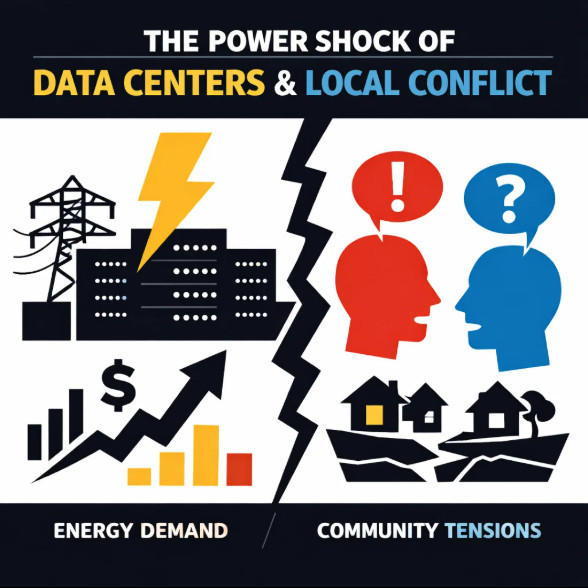
In the age of artificial intelligence, data centers are no longer quiet digital infrastructure. Their massive electricity demand is simultaneously shaking electricity prices, transmission grids, regional development, and public acceptance. The core of competition over data centers now lies not in the number of servers, but in where and how quickly electricity can be connected.
A once-invisible facility has moved into the center of local conflict
For a long time, data centers were facilities that barely caught people’s attention. They were regarded as the warehouses of the digital age, quietly running in the background of every act of internet searching, video watching, shopping, and file storage. For most people, data centers were little more than background facilities—something they would neither encounter directly nor consciously think about. But now the situation has changed completely. Data centers are no longer invisible infrastructure quietly operating in the background. They now stand at the center of debate over which city they are built in, how much electricity they consume, and what local communities gain or lose from them.
The biggest background to this change is artificial intelligence. As generative AI has spread, the nature of data centers themselves has changed. In the past, data centers were closer to spaces for storing and distributing information. Now they are closer to giant factories performing enormous amounts of computation. Every process involved in answering questions, generating images, analyzing video, and training language models requires astonishing amounts of electricity, semiconductors, and cooling equipment. People experience artificial intelligence as a service on a screen, but behind that screen, extremely heavy physical infrastructure is running without pause.
The problem is that this physical foundation creates rougher and more realistic conflicts than many expected. When a data center comes in, a region may initially welcome it. That is because it can bring expectations of new investment, tax revenue, some jobs, and a high-tech industrial image. But over time, other questions follow. Why does it have to consume so much electricity? Who expands the transmission grid and bears the cost of supplying that electricity? Do the benefits really return to local residents? In the end, data centers become not only symbols of future industry, but also conflict-inducing facilities directly tied to daily life in local communities. The most futuristic symbol of the digital economy ends up generating some of the most traditional forms of local conflict.
In the age of artificial intelligence, the battleground is shifting from servers to power connections
One of the most important phrases in the data center industry today is power connection. Put simply, the success or failure of a project is increasingly determined by how quickly and how stably electricity can be connected. In the past, the key was to secure good land, ensure strong telecommunications links, and find a location close to customers. Now that is no longer enough. No matter how attractive a site may be, if it cannot be connected to the power grid, a data center is effectively nothing more than an empty shell.
What matters here is that a power shortage does not necessarily mean a shortage of power plants. Even if electricity can be generated, if it cannot be delivered stably to the desired location at the desired time, it is almost the same as not having it at all. Transmission lines, substations, distribution facilities, and backup power systems cannot be expanded quickly in the short term. Permitting, land compensation, local opposition, and construction periods all take a long time. By contrast, demand for data centers is growing much faster along with the spread of artificial intelligence. It is exactly this difference in speed that has created the current power shock.
That is why competition over data centers is increasingly becoming a fight over who can secure electricity first. In some regions, projects are delayed because their turn in the grid-connection queue comes too late, while some companies postpone actual construction even after securing land. When power connection is delayed, financing, customer contracts, and equipment deployment schedules all begin to shake. People tend to think of digital industries in terms of software and platform competition, but in reality, we have entered an era in which electricity and one’s place in the grid queue shape the business model itself. The artificial intelligence industry is a competition of code, but at the same time it is also a competition over the power grid.
This trend is likely to become even stronger in the future. AI services require ever more computation, and companies want faster responses and larger models. That means more servers, larger data centers, and greater importance placed on power connections. It may appear that the competition is over the future of industry, but in reality, the winner may be decided by who secures spare capacity in substations and transmission networks first.
The question of electricity prices is ultimately the question of who pays the cost
Another reason conflict over data centers is intensifying is electricity pricing. Many people know that data centers consume a great deal of electricity, but the more important issue is how the costs required to supply that electricity are divided. When data centers cluster in one place, it is not just electricity consumption that increases. The grid must be reinforced, substations must be added, and transmission lines must be expanded. Whether all of these costs are borne by data center operators themselves, or whether they are ultimately shared by ordinary consumers, other industries, and local communities, becomes a sensitive point of contention.
From the companies’ point of view, they emphasize the investment and economic benefits they bring. From the region’s point of view, this logic can seem fairly persuasive at first. There are expectations that attracting high-tech industry will boost the city’s image and bring in related businesses. But over time, residents begin to ask more concrete questions. How many jobs are actually being created? How much money remains in the local economy? Compared with that, how great is the burden we are being asked to bear in terms of the power grid and changes to our living environment? The moment people begin to feel that the balance between the taxes companies pay and the costs the region bears is out of line, the welcoming mood can cool very quickly.
At that point, electricity pricing becomes not just a matter of numbers, but a matter of fairness. Residents ask why everyone should bear the burden for someone else’s massive electricity consumption. Power companies and governments may say support is needed in the name of industrial competitiveness, but local communities understand the issue in the language of everyday life. In the end, the core of the pricing debate is not technology but distribution. It is a matter of who uses how much, who pays how much, and who ends up carrying the burden in what way.
In South Korea as well, this debate is likely to become increasingly important. In particular, if data centers continue to cluster in regions like the Seoul metropolitan area, where electricity consumption is high but self-sufficiency conditions are not generous, the burden of reinforcing transmission infrastructure and maintaining the grid will continue to grow. In this process, whether industrial electricity rates should be divided more finely according to regional realities, or whether the current relatively uniform system should be maintained, is likely to become a more frequent source of debate. In the end, the question of electricity pricing for data centers is no longer just a matter of industrial policy, but a social issue asking what principles should govern the operation of the power system.
In location competition, electricity and public acceptance now matter more than land prices
At a glance, data centers may look like simple buildings, but their actual siting requirements are highly demanding. They need strong telecommunications networks, stable power supply, large plots of land, and the ability to operate cooling systems. Recently, another factor has also emerged strongly: public acceptance. In other words, locating a data center is no longer simply a matter of finding the cheapest land. It is a complex issue involving electricity, water, telecommunications, local politics, and the living environment all at once.
Areas near major cities are especially attractive to data center companies. They are close to customers, can reduce network latency, and make it easier to secure talent. But the problem is that large cities often do not have ample spare capacity in the power grid. Residential, commercial, and industrial demand is already concentrated there. So companies want to stay near the city, while the power system tells them to go to outlying areas or regional locations where there is more room. That contradiction is where siting conflicts begin in earnest.
The reasons local residents oppose such projects are not simple either. Data centers have no smokestacks, and because visible pollution appears limited, they were once seen as facilities that might provoke relatively little resistance. In reality, however, there are quite a few factors that affect daily life, including noise, visual impact, the conspicuous presence of cooling equipment, large-scale power infrastructure expansion, and the inconvenience caused during construction. Above all, residents ask what benefit returns to their lives when such a large facility moves in. If jobs are fewer than expected, or if the spillover effect on the local economy feels limited, opposition can grow even stronger.
That is why future competition over data center locations is likely to be reduced to three main criteria. First, can electricity be connected quickly? Second, is the cost structure something the company can bear over the long term? Third, is the project presented in a form that the local community can accept? If even one of these three is missing, the project may falter. Data centers are no longer merely construction projects. They are becoming political-economic projects that must secure both electricity and the consent of local communities at the same time.
The power shock of data centers is ultimately a test of a new industrial order
The power conflicts now unfolding around data centers are difficult to dismiss as mere growing pains of a single industry. They are closer to signals showing in advance how the industrial order of the future may change. For a long time, people assumed that digital industries were less constrained by physical limits. Online platforms, software, and AI services operate on screens, so they seemed less bound by the material world. But the issue of data centers shows the exact opposite. Digital industries, too, are ultimately built on electricity, land, water, and transmission networks. No matter how far technology advances, expansion will stop if the physical foundation does not keep up.
In that sense, data centers reveal the true face of future industry. The more important an industry becomes, the more likely it is to require more electricity, a more sophisticated power grid, faster interconnection, and greater public acceptance. Semiconductor plants, battery factories, AI infrastructure, electric-vehicle charging networks, and hydrogen industries may all face similar issues. The conflicts that surfaced first in data centers may eventually spread to other industries as well. That is why this is by no means a problem affecting only a handful of tech companies.
At the national level, the question becomes even clearer. In the age of artificial intelligence, the winner may not be determined solely by who builds the smartest algorithms. It may matter far more who can connect electricity faster, operate the grid more stably, divide costs more fairly, and grow industry with fewer social conflicts. Data centers are standing at the very front of that test.
What is needed, therefore, is not a simple yes-or-no stance. Neither the attitude of unconditionally attracting data centers nor the attitude of unconditionally blocking them is realistic. What matters is the conditions. Where they are built, who pays the cost, how electricity is connected, what benefits are returned to local residents, and how strongly energy efficiency, self-generation, and energy storage utilization are required—these are the more important questions. It is not enough merely to keep up with the speed of technology. The order of electricity that supports that technology must be designed as well.
What will change in the future?
The conflicts surrounding data centers are unlikely to remain a temporary phenomenon. Rather, this appears to be only the beginning. As AI services become more widely used, and as companies demand larger models and faster processing speeds, the electricity demand of data centers is likely to rise even more steeply. The problem is that the power grid cannot easily keep pace with that speed. As a result, future competition will shift away from a simple race to add more servers, and toward a race over who can secure electricity more quickly, who can receive it more stably, and who can bear the costs with less controversy.
First, data center locations are likely to move in a much more decentralized direction. Until now, the Seoul metropolitan area and major cities have enjoyed an advantage, but in the future, spare power capacity and access to transmission networks may become more important criteria. Companies may begin to prioritize places where electricity can actually be connected, rather than only places close to customers. As a result, the industry may gradually shift from a metropolitan concentration model to a power-hub decentralization model. This could create new opportunities for regional areas, but at the same time it could intensify competition and conflict among regions seeking to attract projects.
Second, electricity pricing systems are also likely to become far more segmented. If electricity-intensive industries also intensify the burden on the grid, then the argument that pricing should reflect not only usage volume but also regional power conditions and grid burden is likely to gain strength. Even if industrial electricity is still grouped together under a common category now, in the future the cost structure may increasingly differ according to where and how much electricity is used. For companies, this would be a burden, but from another angle it could also reduce the incentive to cluster unconditionally in the capital region.
Third, data centers are likely to evolve from facilities that simply consume electricity into facilities that must actively manage their own power use. In the past, the most important thing was to receive a stable and continuous electricity supply. In the future, however, conditions such as energy storage systems, on-site generation, renewable-energy integration, and improved cooling efficiency may become close to essential. In other words, data centers will come under pressure to be designed not as entities that merely draw power one-way from the grid, but as facilities that help reduce the burden on it. This also means that the focus of competition will widen from computing performance alone to energy-efficiency competition as well.
Fourth, the consent of local residents is likely to emerge as a far more important variable. In the past, the label of “high-tech industry” alone was often enough to provide a certain degree of legitimacy. That is no longer true. Residents will begin to ask more specific questions. Why must it be our area? What benefit comes back to us? Who is responsible for the noise, grid burden, and development pressure we are expected to bear? Data center projects that cannot answer these questions properly are likely to be stopped more often at the permitting stage. In the end, data center development will not be something achieved by technology and capital alone. We are likely entering an era in which the ability to negotiate with local communities becomes part of a project’s competitiveness.
Fifth, at the national level, data centers are likely to be treated simultaneously as objects of industrial policy and as security infrastructure. As artificial intelligence, cloud services, defense, finance, and public administration all become more deeply dependent on data centers, these facilities will no longer be seen as mere private-sector installations, but as core infrastructure supporting national functions. If that happens, governments will be more likely to intervene strategically not only in attracting more data centers, but also in deciding where they are placed and how they are operated within the power system. Data center policy would then move to the intersection of industrial policy, energy policy, regional balance policy, and national security policy.
In the end, the future is relatively clear. There will be more data centers, and power-related conflict is likely to intensify. At the same time, however, how precisely those conflicts are managed will determine the competitiveness of each region and country. The strongest places may not be those that can simply consume the most electricity, but those that can allocate electricity fairly and connect it in ways that society can accept. The winner in the age of artificial intelligence may not be the side with the flashiest technology, but the side that designs the most realistic order of electricity.
The power shock of data centers has already begun
The power shock of data centers has already begun. And this conflict is likely to appear more often and on a larger scale in the future. But this phenomenon is not only a crisis; it is also an opportunity. Regions and countries that solve this problem properly may do more than simply attract a few more data center buildings. They may be the ones that set the rules of future industry first.
Data centers are no longer just simple server buildings. They are places where electricity, industry, local communities, and national strategy come together to test the future. Their success will likely depend less on the size of the buildings than on how electricity is connected, how costs are divided, and how the consent of local communities is secured.
The real competition in the age of artificial intelligence is not taking place only inside server rooms. That competition has already begun together on transmission lines, in substations, on electricity pricing charts, and in the lives of local residents.
Reference
International Energy Agency, Energy and AI: Energy demand from AI
Reuters, US power use to beat record highs in 2026 and 2027 as AI use surges, EIA says
Reuters, US power demand surge from data centers could lift fossil fuel generation, EIA says
Central Statistics Office Ireland, Data Centres Metered Electricity Consumption 2024
Reuters, France to harness nuclear power for AI data centres, says MacronReuters, A backlash against data centres is spilling into French municipal election races
데이터센터 전력 쇼크와 지역 갈등
인공지능 시대의 데이터센터는 더 이상 조용한 디지털 인프라가 아니다. 막대한 전력 수요는 전기요금, 송전망, 지역 개발, 주민 수용성까지 동시에 흔들고 있다. 이제 데이터센터 경쟁의 핵심은 서버 숫자가 아니라, 전기를 어디서 얼마나 빨리 연결받을 수 있는가에 달려 있다.
보이지 않던 시설이 지역 갈등의 한가운데로 들어왔다
한동안 데이터센터는 사람들 눈에 잘 띄지 않는 시설이었다. 인터넷 검색을 하고, 동영상을 보고, 쇼핑을 하고, 파일을 저장하는 모든 과정 뒤에서 묵묵히 돌아가는 디지털 시대의 창고처럼 여겨졌다. 대부분의 사람들에게 데이터센터는 직접 마주칠 일도, 굳이 의식할 일도 없는 배경 시설에 가까웠다. 하지만 지금은 상황이 완전히 달라졌다. 데이터센터는 더 이상 조용히 돌아가는 보이지 않는 인프라가 아니다. 어느 도시에 들어서는지, 얼마나 많은 전기를 쓰는지, 지역사회가 무엇을 얻고 무엇을 잃는지를 둘러싸고 논쟁의 중심에 서고 있다.
이 변화의 가장 큰 배경은 인공지능이다. 생성형 인공지능이 확산되면서 데이터센터의 성격 자체가 달라졌다. 과거의 데이터센터가 정보를 저장하고 유통하는 공간에 가까웠다면, 이제는 엄청난 연산을 수행하는 거대한 공장에 가깝다. 질문에 답하고, 이미지를 만들고, 영상을 분석하고, 언어모델을 학습시키는 모든 과정에는 상상을 넘는 양의 전기와 반도체, 냉각 설비가 필요하다. 사람들은 인공지능을 화면 속 서비스로 느끼지만, 그 뒤에서는 매우 무거운 물리적 시설이 쉬지 않고 돌아가고 있다.
문제는 이 물리적 기반이 생각보다 훨씬 거칠고 현실적인 갈등을 불러온다는 점이다. 데이터센터가 들어오면 지역은 처음에는 반길 수 있다. 새로운 투자와 세수, 일부 일자리, 첨단산업 이미지에 대한 기대가 있기 때문이다. 그러나 시간이 지나면 다른 질문이 뒤따른다. 왜 이렇게 전기를 많이 써야 하는가. 그 전기를 위해 누가 송전망을 늘리고 비용을 부담하는가. 그 혜택은 정말 지역 주민에게 돌아오는가. 결국 데이터센터는 미래 산업의 상징이면서도 동시에 주민 생활과 맞닿은 갈등 시설이 된다. 디지털 산업의 가장 미래적인 상징이, 오히려 가장 전통적인 지역 갈등을 불러오는 셈이다.
인공지능 시대의 승부처는 서버가 아니라 전력 연결이 되고 있다
지금 데이터센터 산업에서 가장 중요한 말 가운데 하나는 전력 연결이다. 쉽게 말해, 전기를 얼마나 빨리, 얼마나 안정적으로 연결받을 수 있느냐가 사업의 성패를 좌우하게 됐다는 뜻이다. 예전에는 좋은 땅을 확보하고, 통신망이 잘 연결되며, 고객과 가까운 위치를 찾는 것이 핵심이었다. 이제는 그것만으로는 부족하다. 아무리 좋은 부지가 있어도 전력망에 연결되지 않으면 데이터센터는 사실상 껍데기에 불과하다.
여기서 중요한 것은 전력 부족이 꼭 발전소 부족만을 뜻하지 않는다는 점이다. 전기를 만들어낼 수 있어도, 그 전기를 원하는 장소에 원하는 시점에 안정적으로 보낼 수 없으면 실제로는 쓸 수 없는 것과 비슷하다. 송전선과 변전소, 배전 설비, 예비전원 체계는 단기간에 쉽게 늘어나지 않는다. 인허가와 토지 보상, 지역 반대, 공사 기간이 길게 걸리기 때문이다. 반면 데이터센터 수요는 인공지능 확산과 함께 훨씬 빠르게 늘어난다. 바로 이 속도 차이가 지금의 전력 쇼크를 만든다.
그래서 데이터센터 경쟁은 점점 누가 먼저 전기를 확보하느냐의 싸움으로 바뀌고 있다. 어떤 지역은 전력망 연결 순번이 늦어져 계획이 밀리고, 어떤 기업은 부지를 확보하고도 실제 착공을 늦춘다. 전력 연결이 늦어지면 자금 조달과 고객 계약, 장비 도입 일정까지 모두 흔들린다. 디지털 산업이라고 하면 보통 소프트웨어와 플랫폼 경쟁을 떠올리기 쉽지만, 현실에서는 전기와 전력망의 순번이 사업 모델을 좌우하는 시대가 된 것이다. 인공지능 산업은 코드 경쟁이면서 동시에 전력망 경쟁이기도 하다.
이 흐름은 앞으로 더 강해질 가능성이 크다. 인공지능 서비스는 점점 더 많은 연산을 요구하고, 기업들은 더 빠른 응답과 더 큰 모델을 원한다. 그러면 결국 서버는 더 많아지고, 데이터센터는 더 커지고, 전력 연결의 중요성은 더 높아진다. 산업의 미래를 놓고 경쟁하는 줄 알았는데, 실제로는 누가 더 먼저 변전소와 송전망의 여유를 차지하느냐가 승부를 가르게 되는 셈이다.
전기요금의 문제는 결국 누가 비용을 낼 것인가의 문제다
데이터센터 갈등이 커지는 또 다른 이유는 전기요금 때문이다. 많은 사람들이 데이터센터가 전기를 많이 쓴다는 사실은 알고 있지만, 더 중요한 것은 그 전기를 공급하기 위해 필요한 비용이 어떻게 나뉘느냐이다. 데이터센터가 몰리면 단지 전기 사용량만 늘어나는 것이 아니다. 계통을 보강해야 하고, 변전소를 늘려야 하며, 송전선도 확충해야 한다. 이런 비용이 모두 데이터센터 사업자에게만 돌아가는지, 아니면 결국 일반 소비자와 다른 산업, 지역사회가 함께 떠안게 되는지가 민감한 쟁점이 된다.
기업 입장에서는 자신들이 가져오는 투자와 경제효과를 강조한다. 지역 입장에서도 초기에 이런 논리는 꽤 설득력이 있다. 첨단산업을 유치하고, 도시 이미지를 높이고, 관련 기업을 더 불러들일 수 있다는 기대가 있기 때문이다. 하지만 시간이 흐르면 주민들은 더 구체적인 질문을 던지기 시작한다. 일자리는 얼마나 생겼는가. 지역경제에 남는 돈은 얼마나 되는가. 그에 비해 우리가 감당해야 하는 전력망 부담과 생활환경 변화는 얼마나 큰가. 기업이 내는 세금과 지역이 치르는 비용 사이의 균형이 맞지 않는다고 느끼는 순간, 환영 분위기는 빠르게 식을 수 있다.
이때 전기요금은 단순한 숫자가 아니라 공정성의 문제가 된다. 주민들은 왜 누군가의 대규모 전력 사용을 위해 우리 모두가 부담해야 하느냐고 묻는다. 전력회사와 정부는 산업 경쟁력을 이유로 지원이 필요하다고 말할 수 있지만, 지역사회는 생활의 언어로 받아들인다. 결국 요금 논쟁의 핵심은 기술이 아니라 분배다. 누가 얼마나 많이 쓰고, 누가 얼마나 많이 내며, 누가 어떤 방식으로 부담을 떠안느냐의 문제다.
한국에서도 이 논의는 점점 더 중요해질 수밖에 없다. 특히 수도권처럼 전력 소비는 많지만 자급 여건은 넉넉하지 않은 지역에 데이터센터가 계속 몰리면, 송전망 보강과 계통 유지의 부담은 점점 커질 수 있다. 이 과정에서 산업용 전기요금을 지역 현실에 따라 더 세밀하게 나눌 것인지, 아니면 지금처럼 상대적으로 단일한 체계를 유지할 것인지가 더 자주 논쟁거리가 될 가능성이 크다. 결국 데이터센터 전기요금 문제는 산업정책의 문제가 아니라, 전력 체계를 어떤 원칙으로 운영할 것인가를 묻는 사회적 문제로 번지고 있다.
입지 경쟁은 이제 땅값보다 전기와 주민 수용성이 더 중요하다
데이터센터는 겉으로 보면 단순한 건물처럼 보이지만, 실제 입지 조건은 매우 까다롭다. 통신망이 좋아야 하고, 전력 공급이 안정적이어야 하며, 넓은 부지가 필요하고, 냉각 설비를 운영할 수 있어야 한다. 여기에 최근에는 또 하나의 변수, 즉 주민 수용성이 강하게 떠오르고 있다. 다시 말해, 이제 데이터센터 입지는 단지 땅값이 싼 곳을 찾는 문제가 아니다. 전기와 물, 통신, 지역정치, 생활환경이 모두 얽힌 복합 문제다.
특히 대도시 주변은 데이터센터 기업에게 매력적이다. 고객과 가깝고, 네트워크 지연을 줄일 수 있으며, 인력 확보도 쉽다. 하지만 문제는 대도시일수록 전력망 여유가 충분하지 않은 경우가 많다는 점이다. 이미 주거와 상업, 산업 수요가 몰려 있기 때문이다. 그래서 기업은 대도시 근처를 원하지만, 전력 시스템은 오히려 여유가 있는 외곽이나 지방으로 가라고 말하는 모순이 생긴다. 여기서 입지 갈등이 본격적으로 시작된다.
지역 주민이 반대하는 이유도 단순하지 않다. 데이터센터는 굴뚝이 없고 눈에 띄는 오염이 적다고 여겨져 한때 상대적으로 덜 거부감을 받는 시설처럼 보였다. 그러나 실제로는 소음과 경관 문제, 냉각설비의 존재감, 대규모 전력 인프라 확충, 공사 기간 동안의 불편 등 생활에 영향을 주는 요소가 적지 않다. 무엇보다도 주민들은 이 큰 시설이 들어오는데 우리 삶에 어떤 이익이 돌아오느냐를 묻는다. 일자리가 기대보다 적거나, 지역경제 파급효과가 제한적이라고 느껴지면 반발은 더 커질 수 있다.
그래서 앞으로 데이터센터 입지 경쟁은 세 가지 기준으로 압축될 가능성이 크다. 첫째, 전기를 빨리 연결할 수 있는가. 둘째, 기업이 장기적으로 감당할 수 있는 비용 구조인가. 셋째, 지역사회가 납득할 수 있는 형태인가. 이 셋 중 하나라도 빠지면 사업은 흔들릴 수 있다. 데이터센터는 이제 단순한 건설 프로젝트가 아니라, 전력과 지역사회의 동의를 동시에 얻어야 하는 정치경제 프로젝트가 되고 있다.
데이터센터 전력 쇼크는 결국 새로운 산업질서의 시험대다
지금 벌어지는 데이터센터 전력 갈등은 단순히 한 산업의 성장통이라고 보기 어렵다. 그것은 앞으로의 산업질서가 어떻게 바뀔지를 먼저 보여주는 신호에 가깝다. 그동안 사람들은 디지털 산업이 물리적 제약을 덜 받는다고 생각해왔다. 온라인 플랫폼과 소프트웨어, 인공지능 서비스는 화면 속에서 작동하니 현실의 제약을 덜 받는 것처럼 느껴졌다. 그러나 데이터센터 문제는 정반대의 사실을 보여준다. 디지털 산업도 결국 전기와 땅, 물과 송전망 위에 세워진다. 기술이 아무리 앞서가도 물리적 기반이 따라주지 않으면 확장은 멈출 수밖에 없다.
이 점에서 데이터센터는 미래 산업의 민낯을 보여준다. 앞으로 중요한 산업일수록 더 많은 전력과 더 정교한 전력망, 더 빠른 계통 연결, 더 높은 지역 수용성이 필요할 가능성이 크다. 반도체 공장과 배터리 공장, 인공지능 인프라, 전기차 충전망, 수소 산업까지 모두 비슷한 문제를 마주할 수 있다. 데이터센터에서 먼저 터진 갈등은 결국 다른 산업으로도 번질 수 있다. 그래서 이 문제는 결코 일부 기술기업만의 문제가 아니다.
국가 차원에서 보면 질문은 더욱 선명해진다. 인공지능 시대의 승자는 누가 더 똑똑한 알고리즘을 만드느냐만으로 결정되지 않을 수 있다. 누가 더 빠르게 전기를 연결하고, 누가 더 안정적으로 전력망을 운영하며, 누가 더 공정하게 비용을 나누고, 누가 더 적은 사회적 갈등으로 산업을 키우느냐가 훨씬 중요해질 수 있다. 데이터센터는 그 시험대의 가장 앞줄에 서 있다.
결국 필요한 것은 단순한 찬반이 아니다. 데이터센터를 무조건 유치하자는 태도도, 무조건 막자는 태도도 현실적이지 않다. 중요한 것은 조건이다. 어디에 지을 것인지, 누가 비용을 낼 것인지, 어떤 방식으로 전기를 연결할 것인지, 지역 주민에게 어떤 이익을 돌려줄 것인지, 에너지 효율과 자가발전, 저장장치 활용을 얼마나 요구할 것인지가 더 중요하다. 기술의 속도를 따라가는 것만으로는 부족하다. 그 기술을 떠받칠 전력의 질서까지 함께 설계해야 한다.
앞으로는 무엇이 달라질까
앞으로 데이터센터를 둘러싼 갈등은 일시적 현상에 그치지 않을 가능성이 크다. 오히려 지금은 시작 단계에 가깝다. 인공지능 서비스가 더 널리 쓰이고, 기업들이 더 큰 모델과 더 빠른 처리 속도를 요구할수록 데이터센터의 전력 수요는 더 가파르게 늘어날 가능성이 높다. 문제는 그 속도를 전력망이 그대로 따라가기 어렵다는 점이다. 결국 앞으로의 경쟁은 단순한 서버 증설 경쟁이 아니라, 전기를 누가 더 빨리 확보하고, 누가 더 안정적으로 공급받으며, 누가 그 비용을 덜 논란 있게 감당하느냐의 경쟁으로 바뀔 것이다.
첫째, 데이터센터 입지는 지금보다 훨씬 더 분산되는 방향으로 움직일 가능성이 크다. 지금까지는 수도권이나 대도시 주변이 유리했지만, 앞으로는 전력 여유와 송전망 접근성이 더 중요한 기준이 될 수 있다. 기업들은 고객과 가까운 곳만 찾기보다, 전기를 실제로 연결받을 수 있는 곳을 더 중시하게 될 것이다. 그 결과 데이터센터 산업은 대도시 집중형에서 전력거점 분산형으로 조금씩 이동할 가능성이 있다. 이는 지방에 새로운 기회가 될 수도 있지만, 동시에 지역 간 유치 경쟁과 갈등을 더 자극할 수도 있다.
둘째, 전기요금 체계도 지금보다 훨씬 더 세분화될 가능성이 높다. 전기를 많이 쓰는 산업이 전력망 부담까지 키운다면, 앞으로는 사용량만이 아니라 지역의 전력 사정과 계통 부담까지 요금에 반영해야 한다는 논리가 더 힘을 얻을 수 있다. 지금은 같은 산업용 전기라고 묶여 있더라도, 앞으로는 어디에서 얼마나 쓰느냐에 따라 비용 구조가 달라지는 방향으로 움직일 수 있다. 이것은 기업에게는 부담이지만, 반대로 보면 무조건 수도권에 몰릴 유인을 줄이는 방식이 될 수도 있다.
셋째, 데이터센터는 앞으로 단순한 전력 소비 시설이 아니라 스스로 전력을 조절해야 하는 시설로 바뀔 가능성이 크다. 지금까지는 안정적인 전기를 계속 공급받는 것이 가장 중요했다면, 앞으로는 에너지저장장치와 자가발전, 재생에너지 연계, 냉각 효율 향상 같은 조건이 사실상 필수에 가까워질 수 있다. 다시 말해, 데이터센터도 전기를 일방적으로 받아 쓰는 존재가 아니라 전력망 부담을 줄이는 방식으로 설계되어야 한다는 압박을 받게 될 것이다. 이는 기술 경쟁의 초점이 연산 성능만이 아니라 에너지 효율 경쟁으로까지 넓어진다는 뜻이기도 하다.
넷째, 지역 주민의 동의는 앞으로 훨씬 더 중요한 변수로 떠오를 가능성이 높다. 예전에는 첨단산업이라는 이름만으로 어느 정도 정당성을 얻을 수 있었지만, 이제는 그렇지 않다. 주민들은 점점 더 구체적으로 묻기 시작할 것이다. 왜 우리 지역이어야 하는가. 우리에게 돌아오는 이익은 무엇인가. 우리가 감당해야 하는 소음과 전력망 부담, 개발 압박은 누가 책임지는가. 이 질문에 제대로 답하지 못하는 데이터센터 프로젝트는 앞으로 인허가 단계에서 더 자주 멈춰 설 수 있다. 결국 데이터센터 개발은 기술과 자본만으로 되는 일이 아니라, 지역사회와의 협상 능력이 사업 경쟁력의 일부가 되는 시대에 들어설 가능성이 크다.
다섯째, 국가 차원에서는 데이터센터가 산업정책의 대상이자 안보 인프라로 동시에 다뤄질 가능성이 높다. 인공지능과 클라우드, 국방, 금융, 행정 서비스까지 모두 데이터센터에 더 깊이 의존하게 되면, 이 시설은 단순한 민간 설비가 아니라 국가 기능을 떠받치는 핵심 기반이 된다. 그렇게 되면 앞으로 정부는 데이터센터를 더 많이 유치하는 것만이 아니라, 어디에 어떻게 배치하고 어떤 전력 체계로 운영할 것인지까지 전략적으로 개입하려 할 가능성이 크다. 데이터센터 정책이 산업정책과 에너지정책, 지역균형정책, 국가안보정책이 만나는 지점으로 이동하는 셈이다.
결국 앞으로의 미래는 비교적 분명하다. 데이터센터는 더 많아질 것이고, 전력 갈등도 더 커질 가능성이 높다. 하지만 동시에 그 갈등을 얼마나 정교하게 다루느냐가 각 지역과 국가의 경쟁력을 가를 것이다. 전기를 많이 쓸 수 있는 곳이 아니라, 전기를 공정하게 배분하고 사회적으로 납득 가능한 방식으로 연결할 수 있는 곳이 더 강해질 가능성이 크다. 인공지능 시대의 승자는 가장 화려한 기술을 가진 쪽만이 아니라, 가장 현실적인 전력 질서를 설계한 쪽이 될지도 모른다.
이미 시작된 데이터센터 전력 쇼크
데이터센터 전력 쇼크는 이미 시작됐다. 그리고 이 갈등은 앞으로 더 자주, 더 크게 나타날 가능성이 높다. 하지만 이 현상은 위기인 동시에 하나의 기회이기도 하다. 지금 이 문제를 제대로 풀어내는 지역과 국가는, 단순히 데이터센터 몇 동을 더 유치하는 수준을 넘어 미래 산업의 규칙을 먼저 세우게 될 수 있다.
데이터센터는 더 이상 단순한 서버 건물이 아니다. 그것은 전기와 산업, 지역사회와 국가 전략이 한자리에 모여 미래를 시험하는 장소다. 앞으로 그 성패는 건물의 크기보다, 전기를 어떻게 연결하고 비용을 어떻게 나누며 지역사회의 동의를 어떻게 얻느냐에 달려 있을 가능성이 크다.
인공지능 시대의 진짜 경쟁은 서버실 안에서만 벌어지지 않는다. 그 경쟁은 이미 송전선과 변전소, 전기요금표와 지역 주민의 삶 위에서 함께 시작되고 있다.
Reference
International Energy Agency, Energy and AI: Energy demand from AI
Reuters, US power use to beat record highs in 2026 and 2027 as AI use surges, EIA says
Reuters, US power demand surge from data centers could lift fossil fuel generation, EIA says
Central Statistics Office Ireland, Data Centres Metered Electricity Consumption 2024
Reuters, France to harness nuclear power for AI data centres, says MacronReuters, A backlash against data centres is spilling into French municipal election races